



Behaviors Uncovered: Creativity, Work and Learning Styles
In the first entry in our Behaviors Uncovered series, we investigated four key dimensions for employers focusing on better understanding group dynamics within their teams: Leadership Style, Communication Style, Conflict Management and Team Contribution. In part two, our attention turns to the behavior patterns that shape the ways individuals expand their knowledge base and work together to invent in the workplace: Creativity, Work and Learning Styles.
As a recap, behaviors represent the ranges of observable actions made by individuals in conjunction with their environment. The Talentobe MyPrint® questionnaire provides 11 behavioral dimensions displayed as score matrices resulting from the combination of personality and motivations dimensions of the assessment. Therefore, our behavioral styles are predicted based on the scores (high or low) that an individual has obtained on these two dimensions crossed together. In short, these analytical grids give insights for understanding why an individual tends to foster a particular pattern of actions and how they maintain it.
Creativity Style
Time and time again, creativity is cited as the skill most sought after by employers. After the ways we work were upended due to COVID-19, is it any wonder that companies are looking for ways to boost their knack for finding novel solutions to problems?
How, exactly, you define creativity is key when uncovering the science behind the behaviors in this area. Creativity Style can be described as the set of processes that an individual takes to produce something that is new and somehow valuable, whether it is intangible or concrete.
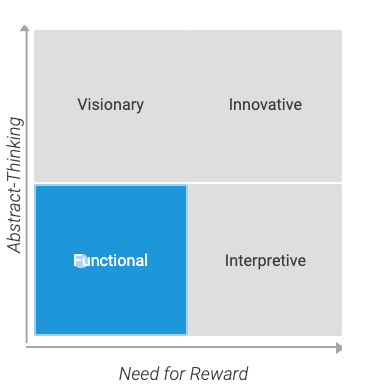
There are four styles of creativity, derived from the “Abstract Thinking” dimension of personality and the “Need for Reward” dimension of motivation:
- Visionary (Imaginative, Need to Contribute to Society): Individuals who have a Visionary creativity style are imaginative and aim for groundbreaking changes that will contribute to the improvement and betterment of others.
- Innovative (Imaginative, Need for Tangible Benefits): Individuals who have an Innovate creativity style like to think outside of the box, and aim to develop new and profitable processes or technologies.
- Functional (Practical, Need to Contribute to Society): Individuals who have a Functional creativity style are realistic, and their creative actions might take place in everyday activities, such as by using existing tools or methods in new and original ways.
- Interpretive (Practical, Need for Tangible Benefits): Individuals who have an Interpretive creativity style are typically looking for quick solutions, and usually come up with more advanced and profitable interpretations of existing techniques or devices.
Work Style
Whether a job requires multiple simple tasks or challenging projects will strongly influence the type of person that you want to work in certain roles. By taking the time to learn about what work style a person uses, you can help to assign roles on certain projects or keep it in mind when hiring for different roles. Work Style refers to the way in which an individual tackles their tasks and projects, as well as the pace at which they complete them.
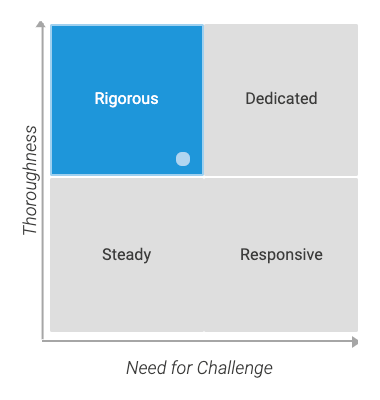
There are four styles of communication, derived from the combination of the “Thoroughness” dimension of personality and the “Need for Challenge” dimension of motivation:
- Rigorous (Precise, Need for Attainable Goals): Individuals who have a Rigorous work style are thorough and task-oriented, and ensure high quality and error free work.
- Dedicated (Precise, Need for Personal Achievement): Individuals who have a Dedicated work style like to work on challenging projects and provide high quality work.
- Steady (Easy-Going, Need for Attainable Goals): Individuals who have a Steady work style value realistic goals and deadlines, and favor consistent productivity by focusing on bottom-line results.
- Responsive (Easy-Going, Need for Personal Achievement): Individuals who have a Responsive work style like challenging goals, and favor multi-tasking in order to do a higher quantity of work in a shorter amount of time.
Learning Style
It’s clear that uncovering the science behind behaviors in areas like learning style will play an integral role in the future of work. In fact, recent reporting indicates that companies are transitioning from hiring based on existing education to focus on skills-based hiring. For this expansion of upskilling efforts to work, employers must first learn how to tap into an individual’s preferred learning style
For our purposes, Learning Style can be summarized as the set of processes that an individual uses to acquire or develop skills or knowledge..
There are four styles of communication, derived from the combination of the “Structure” dimension of personality and the “Need for Recognition” dimension of motivation:
- Studious (Orderly, Need for Intrinsic Enjoyment): Individuals who are Studious learners like to learn things that they find interesting, and prefer learning through methods that allow time to reflect and go at their own pace, such as reading books or articles.
- Sequential (Orderly, Need for External Acknowledgment): Individuals who are Sequential learners are structured and learn best in a lesson format, with clear goals and positive feedback validating their progress.
- Conceptual (Spontaneous, Need for Intrinsic Enjoyment): Individuals who are Conceptual learners like to learn things for fun and do not need structure, but rather will feel like they’ve mastered a topic once they know its full context.
- Experimental (Spontaneous, Need for External Acknowledgment): Individuals who are Experimental learners tend to be intuitive and learn best through group interactions, where they seek positive feedback while testing their new knowledge or skills on others.
As the workplace evolves, employers are putting higher premiums on hiring individuals with the capacity to grow and find new ways to solve problems in their given roles. Understanding the behaviors behind creativity, work and learning styles is an important first step towards building an adaptable team ready to take on the future of work.
In the final entry of our three-part Behaviors Uncovered series, we investigate four areas of behavior that get to the heart of the ways individuals calculate their responses to high pressure situations — Rule Consciousness, Decision Making, Risk Orientation and Change Reaction.
Interested in uncovering more about how behavior profiles can help you understand how someone will act in a professional setting? Discover the science behind MyPrint by clicking here.

New Tailored Group DNA Feature Adds Personalization to Soft Skills Analysis
Talentobe is excited to announce the arrival of the newest feature of Talentobe Manager — Tailored Group DNA! In the last year, our team introduced Talentobe Managers to Group DNA. The idea was simple: Users needed to be able to make smarter HR decisions and maximize synergies within teams by leveraging MyPrint® soft skills data at scale.
Group DNA achieved this with two core purposes in mind: team profiling and talent matching.
- Team Profiling: Group DNA allows users to uncover the soft skills and traits that shape any distinct work group of three or more people. The result is a visual representation of what makes a group effective, and where there are skills gaps to fill.
- Talent Matching: Group DNA improves talent matching by determining the synergies within a job function by taking a sampling of members and allowing Managers to identify the predominant skills that contribute to that groups’ success. Based on that knowledge, candidates can be matched to the role against the Group DNA.
Tailored Group DNA takes this concept one step further by adding personalization options for our users. While Group DNA is a purely data-driven tool which compiles all dominant traits from a sample group of members’ MyPrint data, Tailored Group DNA allows managers to zero-in on the precise traits they may need to focus on for a particular hiring or management situation.
With Tailored Group DNA, you can now find solutions to the following questions:
- How do I leverage Talentobe’s matching algorithm without an ideal sample group to work off of?
- How can I integrate the soft skills that reflect my organization’s values into our selection process?
- How do I leverage my team’s MyPrint insights to create diversity of thought?
It’s time to put a human touch on the data that’s driving your business forward! From hiring to internal mobility, Tailored Group DNA will empower you to fill the soft-skills gaps on your team and put your expertise to good use while maintaining leveraging the scientific integrity of our Group DNA’s matching algorithm.
Interested in seeing Tailored Group DNA in action? Contact our team today to learn more about how our latest feature is changing the way teams visualize and act upon soft skills data!

The Soft Skills Resume is Here to Transform Your Boring Job Search
Resumes are boring! There, I said it. Job seekers know it. Hiring managers know it. Heck, the entire working world knows it! Why, then, are we all creating the same, cookie-cutter resumes over and over again expecting different results?
Thankfully, it doesn’t have to be this way anymore. Toss out that boring, black-and-white career document and say hello to the soft skills resume!
Why Soft Skills?
First things first, let’s sort out why soft skills are so important in today’s hiring landscape. Years ago, the conventional wisdom was that finding a job was a straight-forward process. Either you had the skills to do the job or you didn’t, simple as that! This way of thinking only accounted for technical skills, also known as hard skills. Think of hard skills as the nuts and bolts of how to do the functions of a job that a person could learn through formal education. For example, before a doctor practices medicine, they should definitely go to medical school first.
Soft skills, on the other hand, relate to the unique ways we connect to one another while we work. Examples include communication, leadership and teamwork. While hard skills like education and previous work experience might help you book a job interview, it’s actually soft skills that will ultimately help you land the job.
Unfortunately, identifying soft skills remains a challenge for everyone involved in the job search. In fact, a recent survey from LinkedIn found that while nearly 75% of job seekers polled feel it’s important to highlight their soft skills, the same percentage of hiring managers believe a standard resume is insufficient in evaluating a candidate’s soft skills. Clearly, both sides of the interview table need to find a new way to communicate with each other.
Identifying Your Soft Skills
Soft skill-focused resume writing requires self reflection. To get started, think back to previous work or education experiences and consider the things that made you successful in what you did. Was it your ability to communicate with your peers that set you apart? Did you rely on a knack for scheduling and organizing your day? Maybe you’re a pro at paying attention to all of the details or you found a way to adapt and be flexible when situations changed. The moments of preparation and execution that stand out in these memories are probably going to be your soft skill strengths!
However, the pictures in our minds can only tell a small portion of the soft skills story. To go deeper when identifying what makes you unique, consider taking an assessment backed by science — like MyPrint®! Supporting anecdotal evidence from your career and experiences with tools built on people analytics and strong data can add weight and credibility to your claims.
Creating Your Soft Skills Resume
Once your soft skills are identified, it’s time to transform your resume by making them the stars of the show. This can be accomplished with two key changes to the typical resume format: creating a separate “Skills” section and sprinkling soft skills throughout the rest of your resume.
- Skills Section: At this point in your jobs search, you’ve most likely come across templates for standard resumes that include flashy sections for education and work experience. It’s time to set aside an equal amount of space for a section dedicated to your skills — both hard and soft. To build out this section, start with an exhaustive list of all of your skills. Then, add or remove the skills that best apply to the particular job opportunity.
- Sprinkle Skills Throughout: While facts and figures will provide powerful takeaways in the work experience and education sections of your resume, soft skills can add depth to these areas as well! For example, instead of leaving a bullet point of information feeling cold without context, like, “Compiled spreadsheets for 6 accounts” add a bit of soft skill spice by rephrasing the same bullet point this way, “Applied detailed-orientated thinking during data entry across 6 key accounts.”
Let’s face it, the old days of boring resumes are rapidly falling to the wayside. Today, job seekers and employers alike are putting a premium on tapping into what makes a workplace unique. The best way to highlight your true self in the limited space of a resume is to transform it into a document that puts soft skills front and center!
Do you need more help turning your resume into a showcase of your soft skills? Check out our recent blog post on steps for infusing your MyPrint results directly into your resume!
Talentobe Launches New Website and Logo as U.S. Operations Expand
Talentobe is excited to announce updates to its brand, including the launch of a new website and logo, as operations expand to deepen our presence in the United States.
Talentobe was founded in Paris, France in 2012 to provide science-backed, data-driven talent insights to individuals and businesses. In 2018, Medix, a U.S.-based organization specialized in workforce solutions and recruiting skilled personnel in the Healthcare, Life Sciences, Engineering & Construction, and Technology industries, acquired Talentobe with the goal of enhancing both organizations’ service offerings. Since then, our team has grown to become a global leader in predictive people analytics, providing powerful career, team and workforce intelligence to the world.
“Talentobe has always been a purpose-driven organization, and since expanding into the U.S. market, our core purpose of empowering growth has only grown more important to the work we do,” said Talentobe and Medix CEO Andrew Limouris. “As we find new ways to help businesses and individuals unlock their true potential, our continued, strategic growth in North America will allow us to better serve our clients and community members.”

The completely redesigned logo, website and new brand elements align with significant expansion of Talentobe’s service and product offerings in 2021 and beyond, focused on supporting Corporate HR and Hiring Managers, Higher Education, HR and Coaching Firms and HR Tech Companies.
“The growth of our organization over the last few years has been invigorating, and the new look of our website and brand is designed to reflect and build upon the passion and energy that brought us here,” said Jordan McGuire, Managing Director at Talentobe. “Today, our people intelligence database includes 4+ million profiles from individuals in more than 160 countries. Despite the broad and expanding reach of our tools and technology, we are a company that measures success in people — the careers we support, the teams we build and the businesses we advise.”
Experience the new look of Talentobe and access our latest people analytics products and solutions at www.Talentobe.com.
Behaviors Uncovered: Leadership, Communication, Conflict Management and Team Contribution
How can employers understand how someone will behave in a professional context? Do organizations have to rely on a trial-and-error approach to hiring and management, or is there a way to make better informed decisions based on science?
Thankfully, years of behavioral modeling have left a strong legacy in various fields of psychological research, from social psychology to behavioral economics. Using the progress in this area as a knowledge base, we were able to combine two key areas of results from our MyPrint® questionnaire — personality and motivational traits — to uncover the likely behaviors of individuals in professional settings.
From Personality and Motivations to Behaviors
MyPrint reports consist of three main areas of focus: Personality, Motivations and Behaviors:
- Personality traits correspond to the attitudinal & emotional characteristics underlying people’s stable behaviors.
- Motivations correspond to the desires and needs triggering, orienting and maintaining an individual’s behaviors towards a given objective.
- Behaviors represent the ranges of observable actions made by individuals in conjunction with their environment.
The 11 behavioral dimensions of MyPrint are displayed as score matrices resulting from the combination of personality and motivation dimensions of the assessment. Therefore, the behavioral styles of MyPrint are predicted based on the scores (high or low) that an individual has obtained on the personality and motivation dimensions crossed together. In short, these analytical grids give insights for understanding why an individual tends to foster a particular pattern of actions and how they maintain it.
As we uncover the science behind predicting behaviors in the workplace, we begin with four key dimensions for employers focusing on better understanding group dynamics within their teams: Leadership Style, Communication Style, Conflict Management and Team Contribution.
Leadership Style
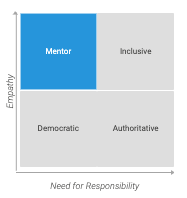
Leadership Style can be described as the way that a person motivates their peers to contribute to the effectiveness of their organization. This applies to individuals formal leadership positions, information leadership positions, or people who might not appear to have any leadership roles at all. Anyone can influence their peers and impact their organization.
There are four styles of leadership, derived from the combination of the “Empathy” dimension of personality and the “Need for Responsibility” dimension of motivation:
- Mentor (Empathetic, Need for Sharing Responsibility): Individuals who are Mentor Leaders build emotional bonds by empowering others and offering plenty of positive feedback.
- Inclusive (Empathetic, Need for Taking Personal Responsibility): Individuals who are Inclusive Leaders drive necessary changes by mobilizing everyone toward a common vision.
- Democratic (Individualistic, Need for Sharing Responsibility): Individuals who are Democratic Leaders guard themselves against backlash by letting others give their inputs upstream.
- Authoritative (Individualistic, Need for Taking Personal Responsibility): Individuals who are Authoritative Leaders tend to demand compliance since they would take full responsibility for issues that may arise.
Communication Style
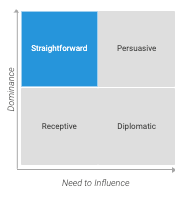
Communication Style can be summarized as the way that a person sends a message to one or many peers, verbally or otherwise. For employees, there’s an ever-growing number of ways to communicate beyond just face-to-face interaction. Understanding the way an individual tends to express their thoughts and opinions during in-person conversations, emails, video calls and more can help predict their future interactions in the workplace.
There are four styles of communication, derived from the combination of the “Dominance” dimension of personality and the “Need to Influence” dimension of motivation:
- Straightforward (Assertive, Need to Open Up to Others’ Opinions): Individuals who are Straightforward Communicators are inclined to clearly state their ideas while keeping a neutral tone and being respectful of others’ views.
- Persuasive (Assertive, Need to Sway Others’ Opinions): Individuals who are Persuasive Communicators are inclined to dominate others in interactions by openly convincing them to see things their way.
- Receptive (Compliant, Need to Open Up to Others’ Opinions): Individuals who are Receptive Communicators are inclined to speak softly in interactions, and mostly listen to others’ points of views in order to please them.
- Diplomatic (Compliant, Need to Sway Others’ Opinions): Individuals who are Diplomatic Communicators are inclined to control the course of discussions to their advantage by placing underlying messages in their spoken words.
Conflict Management
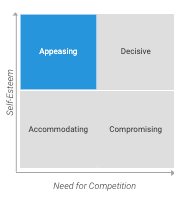
Conflict Management can be described as the way that a person tries to limit the negative aspects of a confrontation while increasing its positive impacts. Conflict doesn’t always take place in the form of direct confrontation. Being aware of the ways in which individuals will handle situations where there are differing opinions — both big and small — can help leaders facilitate as needed so that certain individuals’ voices and opinions are being heard over the individuals who might be more confident and determined to win.
There are four behavior types when it comes to conflict management, derived from the combination of the “Self-Esteem” dimension of personality and the “Need for Competition” dimension of motivation:
- Appeasing (Confident, Need to Cooperate): Individuals who are Appeasing in Conflict tend to dig into the underlying concerns and consider the views of others.
- Decisive (Confident, Need to Win): Individuals who are Decisive in Conflict tend to settle it by asserting their own solution.
- Accommodating (Modest, Need to Cooperate): Individuals who are Accommodating in Conflict put aside their own needs in order to keep the peace with others.
- Compromising (Modest, Need to Win): Individuals who are Compromising in Conflict tend to ignore or withdraw from it rather than facing it.
Team Contribution
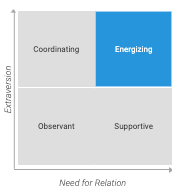
Team Contribution can be summarized as the way that an individual cooperates and works with others in a group setting in order to achieve organizational goals. This is not only useful for individuals who work in the same department or formal team, but for understanding the role a person tends to play even in the informal group projects and activities that occur in the workplace.
There are four ways individuals can approach team contribution, derived from the combination of the “Extraversion” dimension of personality and the “Need for Relation” dimension of motivation:
- Coordinating (Extroverted, Need for Privacy): Individuals who are Coordinating teammates expect efficiency, focus on goals and coordinate people together
- Energizing (Extroverted, Need to Socialize): Individuals who are Energizing teammates get excited and draw others in with enthusiasm, while showing a relatively short attention span.
- Observant (Introverted, Need for Privacy): Individuals who are Observant teammates focus on content, and are likely to ask others about their expectations regarding their role in the process.
- Supportive (Introverted, Need for Socialize): Individuals who are Supportive teammates are loyal team players, by actively listening, discussing and defending the different views of others.
The behaviors results of MyPrint help in understanding the ways in which individuals actually act or conduct themselves, especially toward others. This knowledge can be invaluable in building a more productive workplace.
In our next entry in our three-part Behaviors Uncovered series, we investigate three areas that are critical to the development of highly-effective problem solving teams — creativity, work and learning styles.
Interested in uncovering more about how behavior profiles can help you understand how someone will act in a professional setting? Discover the science behind MyPrint by clicking here.
How to Conduct a Soft Skills Interview in 4 Easy Steps
If you have been following our blog then you know how important we think soft skills are to incorporate into your daily work lives.
“Hard skills will get you the job, but soft skills will make you successful.” -Me, at least 3 times per week
However, sometimes this can seem overwhelming. Where should you, as a manager, start? In this blog article we will take a step-by-step look at how to use soft skills from the very beginning of the employee lifecycle: the interview process.
Step 1: The Job Requirements
At first glance, you might think you know what goes into a position. Maybe you have been hiring for this position for quite some time, or you have worked with individuals in this role before. Although you might think you know all of the important requirements for a role, it is still important to take the proper steps to evaluate a job description in order to make a more informed decision on what the role entails.
Once you have determined what hard skills and qualifications are necessary for a position, it is time to determine what soft skills will help someone be successful in this role. There are many ways to find this information. Here are a few of the common ones:
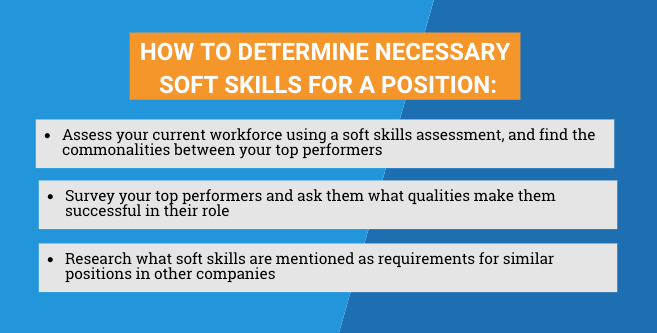
It is very important that you are using a scientifically reliable and valid method to assess your teams’ soft skills. For the purpose of this article, we recommend using the MyPrint® assessment to assess your current workforce and using some of our tools available through Talentobe Manager to determine what to look for during the interview process.
An important note here: although you are looking for commonalities among your top performers, that does not mean that you want a cookie cutter of those individuals. One of the most important things for a team’s success is having diversity among group members to help fill in skills gaps and increase creativity and innovation¹.
Step 2: Preparation
Now that you have determined what the important soft skills are for the position, you need to prepare for the interview. Having a set interview process helps to ensure that you are making more informed decisions for your company and not using personal judgments or unconscious biases when hiring. Topgrading² is one example of an interview methodology that is intended to help identify top talent, and incorporating soft skills into this methodology is seamless.
Prior to the interview starting, you will also want your candidates to complete a MyPrint® assessment (check that their results are from the past 6 months to ensure accuracy). Make sure that the hiring manager and anyone involved in the interview process have taken the time to review the candidate’s MyPrint® One Pager (soft skills summary) and are familiar with the soft skills that have been determined important for the role.
To prepare for the soft skills portion of the interview, we recommend that you have the Premium Report version of the candidate’s results handy and review their top 3 personality strengths, motivators, and behaviors (as shown on the One Pager report). Then ask yourself the following questions:
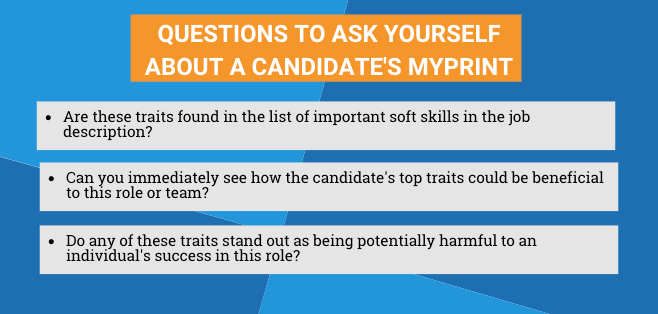
Lastly, take a look at the candidate’s behaviors. The MyPrint® Premium Report has two interview questions tailored to each behavioral style to help gain a better understanding of how that individual showcases those styles. Make a note of any behaviors that you would like to dig deeper on, and have those interview questions ready to go!
Step 3: Conducting the Interview
When conducting a soft skills interview, it is important to stay open minded. If someone’s top three MyPrint® traits aren’t the exact three that you are looking for that does not mean they are not going to be a good candidate. Instead, look at their Premium Report to see where they fall on the scale for each of those traits. Take the time to ask questions around those topics, and make sure that you are being clear about the role expectations and see if that matches what they are looking for.
Step 4: Scoring the Interview
Once the interview is completed and the candidate has left, it is not time to make a decision quite yet! Take the time to review your interview notes and apply some quantitative metrics to what you were looking at.
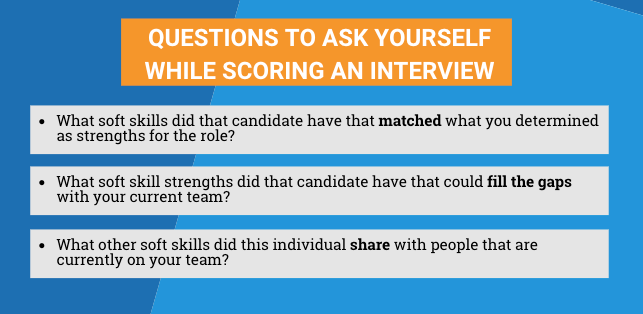
To ensure fairness between candidates, use a standardized method of scoring the interviews. Grading methods can include ranking responses or finding the difference between ideal scores and actual scores in their MyPrint® scales.
To Sum It All Up…
Using soft skills in the interview process can help you make more informed hiring decisions, and help you find candidates who will be more successful in their role. The interview process is an investment for everyone involved, so it is not something that should be done without careful evaluation and purpose.
Remember to be open-minded when it comes to soft skills; you won’t have all of the answers right away. As you gather more information over time you will learn more about what personality traits, motivations, and behavioral styles can be attributed to success in a role and sometimes, what you find might surprise you!
Want more information about soft skill interviewing, or to receive a copy of our template? Email Talentobe at customer@talentobe.com to learn more about our assessment and services!
Sources
¹https://www.managers.org.uk/knowledge-and-insights/listicle/the-five-business-benefits-of-a-diverse-team/
²https://topgrading.com/
How Our Personalities Were Transformed By COVID-19
Human beings are incredibly adaptable. Consider all the ways life has changed in response to the COVID-19 pandemic. From shrinking social circles to becoming comfortable wearing face masks to learning what six feet of distance really looks like, our society has found ways to adjust to a new way of living out of sheer necessity. However, these transformations run even deeper than just what the eye can see. Beyond the obvious signs of physical distancing, people have been adapting to our changing world in other ways — especially when it comes to their personality.
What Our Research Reveals
Based on MyPrint® personality assessment data from the last year, while the core of what makes most individuals unique may have remained intact, there are clear trends that point to changes occurring in our personalities happening broadly. In particular, our research points to changes in the grit, thoroughness, structure and optimism dimensions of personality.
Here’s what the four most prominent changes we’re tracking in personality mean for individuals moving forward. Have you recognized any of these changes in your own personality?
Developing an Opportunistic Approach
Being opportunistic is an important part of the grit dimension of personality. Think of grit as an indicator of how determined an individual may be to stick with something they’ve started. A high level of grit can be a wonderful trait for anyone who is known for seeing every project to its completion. However, as the realities of life during COVID-19 became apparent, most individuals dialed down this particular trait. One explanation is that the situations many people faced required a shift in plans. That determined, or “gritty,” mindset has been shifted to an opportunistic approach, as the need to adapt to rapidly changing circumstances outside of anyone’s control have become more prevalent. In other words, rather than seeing each particular challenge to the end, many of us moved onto new opportunities that fit better into our new world of work.
Becoming More Easy Going
In a year in which many people put on sweatpants and embraced a more laid back approach to their work from makeshift home offices, it might not be all that surprising to learn that thoroughness moved closer to the “easy going” end of our personality scale. What this means is not necessarily an increase in sloppiness, but a preference for a higher quantity of work outputs over the quality of that work. After all, in many roles, the shift in work environments presented any number of new challenges, and an unfamiliar amount of unstructured time with which to get them done.
Prioritizing Spontaneity
Speaking of structure, raise your hand if you forgot which day of the week it was at least once in 2020. If your hand is in the air right now, don’t worry — you are not alone! Our research indicates that personalities dipped in their levels of structure over the course of 2020, leaning further into the spontaneous end of our scale.
Personally, I know my entire routine was completely upended in the last year. In a matter of days, my morning alarms, commute plans, meeting schedule and meal prep strategy went right out the window. Suddenly, if I wanted to sleep an extra hour, that was okay! If I felt like having a homemade omelet for breakfast on any given Wednesday, I could bust out the eggs and get cracking! However, this shift towards less structure also had effects well beyond extra snoozes and creative meals. The lines became blurred around which types of projects needed to be done when. The boundaries between work and home were breached.
Increased Optimism
On the bright side, personalities appear to have been pushed to the positive end of our optimism scale! At first glance, this trend might appear to be counterintuitive. After all, in a year filled with so much darkness, how could optimism be on the rise? It turns out that this may be the greatest indication of human resilience revealed in our analysis. When faced with adversity, individuals have time and time again shown the ability to find even the smallest silver linings in a given situation. As our goals collectively shifted from narrow-minded personal achievements to group survival, small wins became reasons for real celebration.
As vaccinations are administered, the world stands poised to step forward into another stage in the fight against COVID-19. Even as we remain hopeful that this virus will someday fade away entirely, the changes we experienced in our personalities will remain long after the masks are put away. Human beings are incredibly adaptable. While that means individual traits may shift in response to situations beyond our control, what makes us unique carries on.
Are you interested in learning more about how your personality has evolved over time? Take (or retake) the MyPrint® soft skills assessment today to unlock personality insights. Click here to get started.
Are You Missing the Hard Data on Soft Skills?
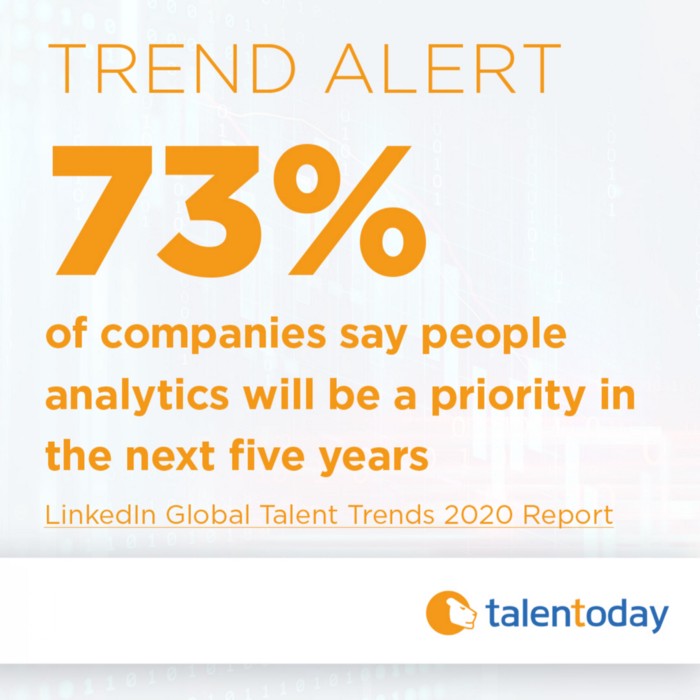
More companies are looking at Big Data to boost their bottom line. In the world of work, they are turning to people analytics to provide predictive insights that save time and money, while bringing out the best in their employees. This information can help organizations envision and realize the full potential of their people.
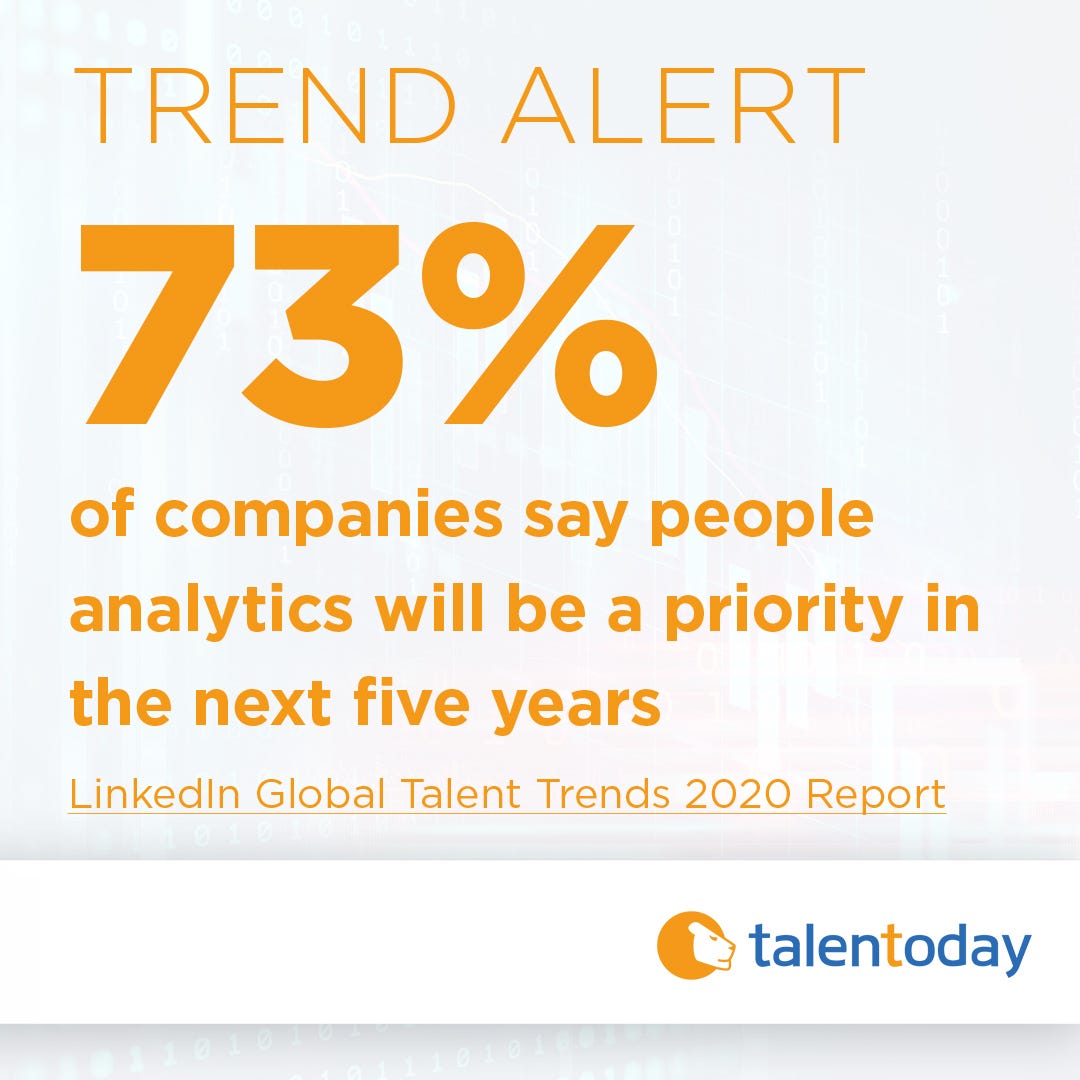
Learn what people analytics software truly means and how to use it to enhance your organization’s growth. A better understanding of the data on soft skills and how it fits into your overall analytics picture can help you align your organization’s goals, values, people, and purpose. It can guide recruitment in finding the right talent to best fit a team and overall organization. Understand the importance of soft skills at every phase of the employee lifecycle:
- RECRUITMENT
- HIRING
- ONBOARDING
- PERFORMANCE
- DEVELOPMENT + TRAINING
Discover how people analytics can help you optimize performance and boost profit, while helping you envision and realize your team’s full potential. Learn ways to enhance your organization’s growth with insights that help you predict and plan. Download our eBook.
COVID-19 Impact on Motivations in the Workforce
It’s been one year since COVID-19 took the world by storm. Countries started to close their borders and government safety regulations were enforced. As a result of unpredictable lockdown and safety measures, each person’s environment has changed in some way. For millions of typical “office workers” this meant working from home, while those deemed essential continued to go into work with increased risk. With all of this change happening externally, there is internal change that comes with it. How has the move to a remote workspace, social distancing, new health measures, and other pandemic outcomes impacted the things that motivate your employees? Let’s learn more about how motivations work first.
One of the most widely accepted motivation theories is Maslow’s Hierarchy of Needs. You may recognize the motivation pyramid that has found its way into most every psychology, marketing, and ethics textbook, and it is the foundation for the Talentobe MyPrint motivation dimensions as well! There are five stages of motivation included in the pyramid: physiological needs, safety needs, love and belongingness needs, esteem needs, and self-actualization needs. The basis of Maslow’s theory is that everyone starts at the bottom stage of the pyramid with their most basic physiological needs: food, water, clothing, and shelter. Once those needs are met, we are able to work our way up to safety, and so on.
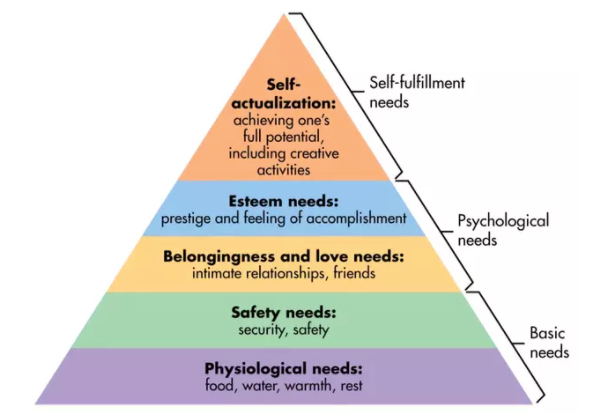
Our environment plays a huge role in our motivations and where we’re at on the pyramid. For example, during the COVID-19 pandemic, we have seen a lot of people focus on addressing their basic safety needs, like employment and financial stability. Other factors that can impact our motivations include, but are not limited to, changes to our work environment, major family events such as births or deaths, changes in our relationship status, living situations, or unforeseen financial events.
Motivations and MyPrint®
Since we know that motivations are so dependent on our environment, we decided to take a look at how the COVID-19 pandemic has impacted the motivations found in MyPrint®. To do this, we calculated the motivations that saw the biggest increase amongst assessment takers before and after March 2020. We observed three dimensions that had a larger increase than the others: Recognition, Responsibility, and Excitement.
Recognition: Need for External Recognition
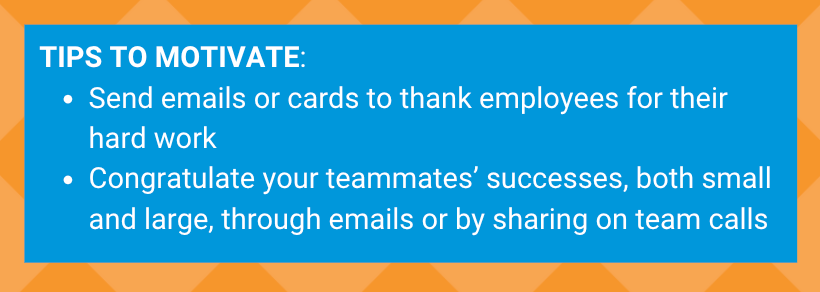
People who have a need for external recognition are driven to work harder when they receive positive feedback and praise from coworkers. When working in an office environment, this will naturally happen more frequently; you tell an employee they did great on a presentation while passing their desk, or congratulate a coworker on hitting a milestone while you’re getting your morning coffee. However, in a remote environment, we need to be more intentional about giving that recognition. Since March 2020, a total of 81% of the global workforce has had their workplace fully or partly closed. Whether this impacts someone directly, or if they are seeing this happen with their friends and loved ones, receiving that external recognition can help to reassure individuals that they are doing a good job and motivate them to continue the good work.
Responsibility: Need for Taking Personal Responsibility
People who have a need for taking personal responsibility are comfortable being held accountable for others’ actions, regardless of error or failure, and are more comfortable being accountable for their own work as well. Moving into a remote work environment means that individuals need to take on more personal responsibilities than they did before: from managing all of their time to taking on pieces of projects that they might not have needed to before. For some people, having more control over their work environment can create that drive to keep them motivated at work.
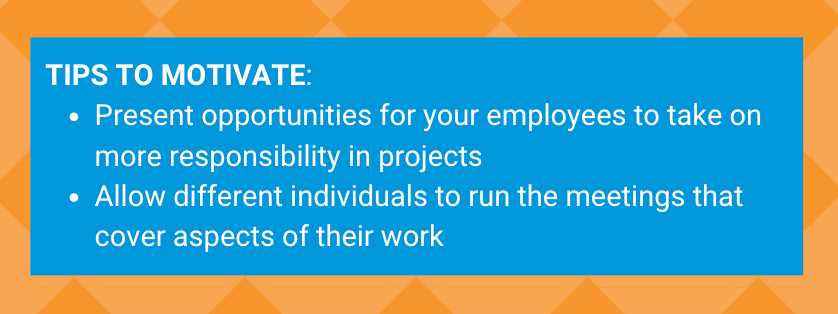
Excitement: Need for Adventure
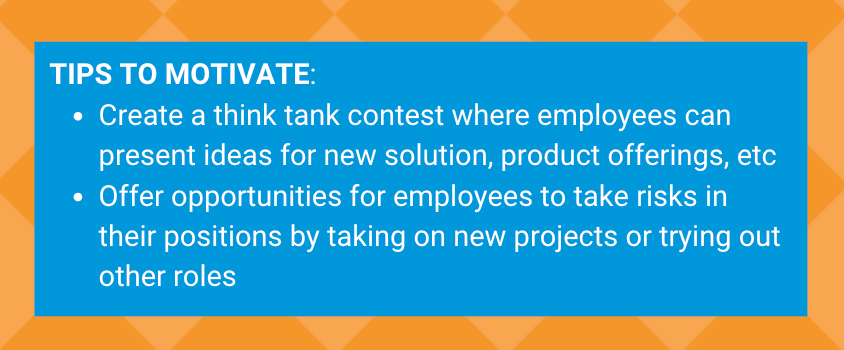
People with a need for adventure are driven by situations that offer thrill, seek to take risks and are very tolerant of unpredictable situations. A lot of people have experienced a more stagnant environment since March of 2020. Whether it is due to stay at home orders, travel restrictions, or lack of a commute, we are all going through it. Because of this, it is not surprising that people are craving more adventure in their lives. Work can be a great place to create excitement — from new opportunities to new roles or training, providing an environment where employees can take more risks and try new things can lead to a more engaged workforce.
Check In With Your Workforce
Your workforce is going to evolve over time, and it is important to keep up with those changes! Whether it’s a global pandemic to impact the shift in motivations, or if it’s typical life events taking place, you want to make sure that you are evolving alongside your employees. Changes to an employee’s motivations means adjusting your management style, and by keeping up with these changes, you can create the most engaging environment for your workforce as possible.
We recommend employees take the MyPrint assessment every 6–12 months. Interested in learning more about MyPrint and how our solutions can help you better understand your workforce? Contact Talentobe at customer@talentobe.com to learn more about our assessment and services!
Social Awareness in the Workplace: Do You Have These 5 Critical Skills for Fostering Diversity, Equity and Inclusion?
Following the mass protests and grassroots social movements that have come to define the summer of 2020, many businesses felt compelled to speak up and reevaluate their diversity, equity and inclusion (DEI) efforts. Not only was it the right thing to do, but recent research from Monster found that, “more than 86% of candidates say that diversity, equity and inclusion in the workplace are important to them and 62% of people would go as far as turning down a job offer if it came from a culture that didn’t support a diverse workforce.” It’s feedback like this from job seekers that earned DEI a spot on Medix’s list of the hiring trends that will define 2021.
Thanks to individual employees, many organizations have recognized the importance of these efforts in the last year; however, achieving the kind of progress being asked for across all industries is another story. According to the Society for Human Resource Management (SHRM), “Organizations cannot become multicultural by proclamation. It takes concerted effort.” In other words, while posts on social media talking about creating a diverse workforce may be a positive step forward, real change requires action at a personal level.
To get there, individuals within an organization need to develop the skills that allow for real growth within a company culture. SHRM identifies five traits leaders and employees alike must focus on when adopting a diverse mindset: Openness, Flexibility, Social Dexterity, Emotional Awareness and Curiosity.
Here’s what research behind soft skills tells us about each of these five critical traits. Through self evaluation, you can identify which areas are strengths for you, and which ones may need some development. By bringing more awareness to these five traits within yourself, you and your teammates can help drive DEI efforts in any organization:
Openness
When it comes to openness, it’s a characteristic that points to a person being “receptive” in terms of their communication style. These people tend to be low in dominance in terms of their personality and don’t feel a need to influence others in order to be motivated. Employees who are able to tap into this sense of openness can be powerful allies as organizations expand their DEI efforts. A workplace that embraces these receptive communication styles allows different opinions and thoughts to be heard in a group, rather than having each person simply caring about their own opinions and trying to convince others to see things their way. Ultimately, the goal is to open up more opportunity for diversity of thought to be expressed and implemented in group settings.
Flexibility
No, flexibility doesn’t just refer to a person’s yoga skills! Rather, it’s an indication of people who may appear lower in grit in terms of personality and have a low need for competition to be motivated. While a lack of grit or competitiveness may sound like a negative to some, what this means is that this person may be more likely to change what they are doing in order to move onto whatever is more valuable for them to be working on — showing that they are flexible and adaptable to their environment.
Think of it this way: When someone is able to switch their focus to what is best for the team, and is also motivated by doing things as a collective effort, then the group as a whole is going to be more open to success. This creates a culture of support for one another, which is key when making diversity a top priority.
Social Dexterity
One of the ways organizations become closed off from the principles of DEI in the workplace is through the forming of cliques — small social circles designed to exclude those with differing interests and opinions. Thankfully, one of the most powerful weapons for breaking through the clique mentality are individuals with high levels of social dexterity. These people energize teams by having highly extroverted personalities and an intense need for relations to be motivated. With social dexterity in a group, there’s less of a chance for ‘outsiders’ to be pushed aside, since those energizing individuals will seek out connections with everyone.
Emotional Awareness
One crucial element of social awareness is emotional awareness, or the ability to make decisions and base actions first and foremost on how it impacts others. In other words, people who understand emotional awareness have highly empathetic personalities and are motivated by their need for belonging. Individuals who put an emphasis around being emotionally aware of those around them are going to help empower an inclusive culture by making sure that nobody is forgotten. By finding ways to allow everyone in a group to feel as though their thoughts and opinions are being considered, these individuals help to make others feel seen and heard within an organization.
Curiosity
Critical thinking personalities are naturally curious; they are motivated by a need for variety in their daily activities. Curious people ask a lot of questions, and this can be an invaluable trait as organizations seek out a path to DEI efforts that work for their organization and team culture. In most cases, curious thinkers are not interested in having cookie cutter individuals on their team. Instead, they are energized by people who have different backgrounds, skills, cultures, and opinions from their own. This helps to empower an inclusive workplace by fostering a culture of learning.
Identify Your Soft Skills to Empower DEI
These five traits — Openness, Flexibility, Social Dexterity, Emotional Awareness and Curiosity — may be the key to unlocking a new era of diversity in the workplace. Do any of them sound familiar to you?
To begin developing these skills within yourself, the first step is measuring where you stand in each category. With that baseline knowledge, it will then be easier to find ways to apply your areas of strength to DEI efforts within your control at an organization. For areas in which you may be deficient, this is a time to create plans for developing in the areas critical for fostering the type of work environment so many are fighting to make a reality.
Looking to learn more about how you can use your soft skills to grow diversity, equity, and inclusion at your organization? Take the MyPrint® soft skills assessment today to unlock personality insights that can drive change!