



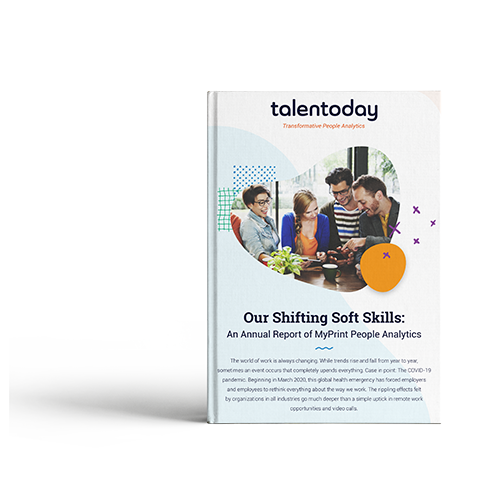
Our Shifting Soft Skills: An Annual Report of MyPrint People Analytics
The world of work is always changing. However, in the last two years, organizations in all industries have to rethink everything about the way we work.
How have your employees changed? Are you ready to adapt your processes to meet their evolving needs?
Learn how to embrace personalized solutions that are driven by the latest soft skills data and tailored to the changing personalities and motivations of the workforce.
Utilizing MyPrint personality assessment results gathered from the start of the COVID-19 pandemic, this report investigates:
- 6 Soft Skills on the Rise
From increased autonomy to a need for more variety, what is driving employees to succeed? - 6 Soft Skills on the Decline
What impact will lower levels of skills like grit and empathy have on your team? - The Effects on Workplace Behaviors
Leadership, work and learning styles are all changing alongside our shifting soft skills.
Click here to download our report detailing the soft skills trends making an impact in the workplace.


Goal Setting Guided by Soft Skills
While there’s never a bad time to set new goals, there sure is something about a fresh new year that boosts motivation! As you take a look at your plans for personal development this year, get a fresh perspective on where you could be going by using your soft skills to guide your goal setting.
Reflect on Where You Currently Stand
When it comes to tackling big goals, it’s important to start with small steps. In order to see how far you have to go, take a look at where you are right now. The skills you possess and the resources you have available can impact the way you set and achieve your goals. Take inventory of what you already have at your fingertips, and keep that into consideration as you determine where you want to go.
Setting Goals with Soft Skills
Next, it’s time to make a plan for what you want to achieve and how you’ll get there. While there are a lot of the goals that might seem like they only require hard skills - such as a certain level of education or required certifications - the truth is that soft skills are the power behind these achievements! By simply being aware of the soft skill strengths you possess, you will be able to better understand how you approach situations and what motivates you, as well as be better equipped to set and reach attainable goals.
Let’s say you want to grow your professional network in the year ahead. Before committing to this goal, it’s important to ask yourself questions about your personality. Are you an introverted person or do you tend to seek a spotlight? If you take the time for self reflection, you can determine what a realistic goal looks like for you and better plan the necessary steps to reach it. For example, if you take a while to warm up around new people, you might make a goal to connect with a certain number of people on LinkedIn each month. However, a more extroverted person might look up conferences or large virtual events that provide an opportunity to dive right into new relationships. Although the end goal is the same, to grow your network, the path to get there might look different from person to person.
Develop a Clear Path Forward
Now that you have a better understanding of where you currently are, take a look at where you want to be and determine a clear path to get there. If you can’t see a plausible way to reach your goal, reevaluate how to set realistic goals in the right direction.
After all, the soft skills you have today can empower your growth tomorrow! Understanding the way you structure your day or what motivates you can help you determine the best way to create a path to your goal. Other goals can be reached by developing soft skills you may not currently use as much. For example, if you have a professional goal to move into a management position at work, you might want to develop some of the most in-demand skills that businesses are looking for when hiring for leadership positions. According to The Balance Careers, these areas of focus can include communication skills, empathy and flexibility.
Whether the path forward utilizes existing skills or is developed with soft skills growth in mind, it’s important to write everything down. Committing to goals mentally is a great first step, but putting them to paper or a digital space helps to make them real. Include checkpoints at regular intervals throughout your journey in order to track progress and adjust goals along the way.
What Are You Waiting For? Get Started!
There’s no time like the present when it comes to self-improvement. Take some time to reflect on the strengths you currently possess, then determine how you can use those skills to get to where you want to be.
Ready to discover your soft skill strengths and improve your goal setting this year? Take our free MyPrint assessment today by clicking here!

The Soft Skills DNA of Remote Workers
Remote workers have taken on growing significance in the U.S. workforce. In fact, a recent poll of employees showed that 39 percent would now consider quitting if their bosses did not provide some sort of work from home option. Clearly, employers need to take remote work seriously as they ponder how to build teams with the future of work in mind.
While remote work had been growing in popularity prior to the COVID-19 pandemic, the global health crisis turned work from home from a nice-to-have option into a necessity for a great deal of companies. The experience highlighted the advantages of a more flexible work environment for many employees and employers alike. However, as with any workplace, some workers adapted more easily to remote working conditions than others. The reason for these differences can be found in the science behind personality traits and workplace motivations.
Remote Work DNA
In an effort to help employers better understand this emerging workforce, psychologists at Talentobe used our Tailored Group DNA tool to create a soft skills model dedicated to remote workers. Users who access this tool within the Talentobe Manager platform will find the predominant personality traits and motivational needs that are necessary for a good adaptation to remote working conditions. Employers can then use this information to compare these benchmarks with the profiles of existing employees and potential job candidates.
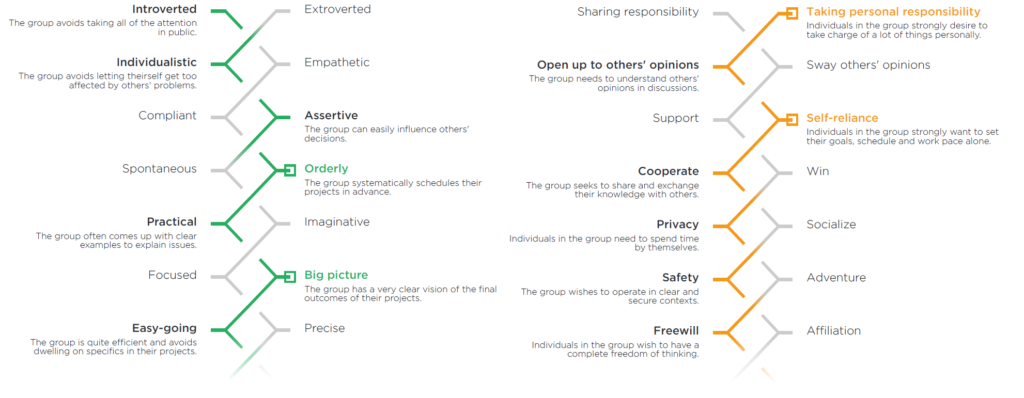
Here’s a preview of our findings:
Predominant Personality Traits
- Orderly: When working from home, it pays to stay organized! This group prefers to schedule projects in advance.
- Big Picture: Even if the home office might be small, the goals for this group are big. Remote workers are more likely to have a clear vision of the final goals of their projects.
- Determined: This group sticks it out when the going gets tough, striving to overcome even the most difficult challenges.
- Positive: A shifting work environment is helped by the right mindset. These individuals have strong confidence in the future.
Predominant Motivations
- Taking Personal Responsibility: Remote workers know that they are the only ones around to hold them responsible for their actions. They tend to keep themselves accountable for their work and decisions.
- Self-Reliance: When you work from home, it pays to be able to set your own goals, schedule and pace of work.
- Personal Achievement: Goal setting is essential when it comes to the flexible work environment. Our research shows this group seeking to achieve highly difficult objectives.
- Intrinsic Enjoyment: When you work alone most of the time, you tend to find motivation from internal forces. Rather than being showered with external accolades, these workers prefer to achieve things for their personal satisfaction.
If recent history is any indication, remote work and other flexible forms of employment are here to stay. Employers looking to build the best teams possible need to start considering more than technical requirements for positions. By applying soft skills research to the hiring and team management process, employers can better predict employee success in a given workplace setting.
Are you interested in learning more about Group DNA from Talentobe? Click here to sign up for your free trial of Talentobe Manager, which includes our Group DNA tailored to the needs of the remote workforce.

Webhelp Case Study: Successful Job Placement with Soft Skills
The Challenge: Lack of Insight into Top Performers’ Skill Sets
With thousands of new hires annually, streamlining the recruiting process had become a critical challenge for Webhelp. In need of a better process to identify top performers for key positions, Webhelp turned to Talentobe to help optimize the job placement process as soon as candidates passed the generic corporate recruitment phase.
The Solution: Optimize Job Placement with Thorough Assessment
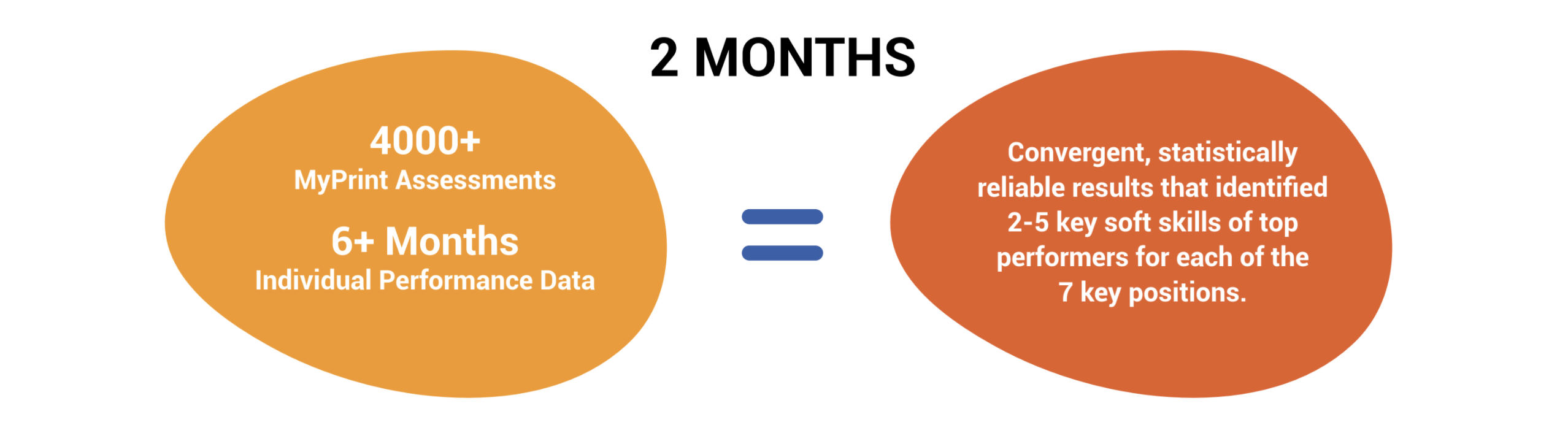
Leveraging MyPrint, Talentobe conducted a massive soft-skills assessment campaign with employees to collect soft skills data. Coupling that with company performance data, Talentobe created a replicable roadmap using traditional descriptional statistics methods and complex machine-learning techniques to identify key soft skills for critical roles.
The Results: More Successful Job Placements Driven by Data
With nearly 4,000 completed My Print assessments, Talentobe was able to provide two to five key soft skills for the top seven positions in the Webhelp organization. This roadmap is used to help Webhelp make personalized job recommendations to candidates based on their MyPrint soft skills assessment. In addition, this study assisted the company in identifying top performers, as well as individuals who needed improvement, in seven critical positions while taking into account cultural differences between countries.
ABOUT THE CLIENT
 Webhelp is a global customer experience and business process outsourcing company, operating across a range of digital, social and traditional voice channels. Webhelp is present in 29 countries, with more than 90 customer experience and payment service centers and over 35,000 people serving 500+ clients.
Soft skills are a key focus in the roles at Webhelp, and Webhelp’s top managers strongly believe in the importance of behavioral science to improve the efficiency of their Human Capital Management practice.
Ready to Start Your Transformative Talentobe Success Story?

How to Cope With Empathy Overload at Work
Do you ever feel like people gravitate towards you to vent? If you hear a coworker telling you about how stressed out they are with their workload, do you offer to lend a hand without considering your own priorities? When making decisions, do you carefully consider the potential impact on others?
If you answered yes to any of these questions, chances are you are a highly empathetic person. The past few months have not been easy for the empaths of the world. Between personal circumstances, situations within your close circle and global events, it is easy to experience empathy overload. It's a condition that can have negative consequences in any setting, especially in the workplace.
Empathy at Work
Every workplace needs empathetic people. In fact, it is often considered one of the most important skills for a successful leader to have. The ability to lead and work with others while anticipating their needs and being aware of their feelings has been shown to have a positive influence on job performance. However, without proper self-care, over reliance on a key soft skill can have negative outcomes.
When empathetic individuals experience a lot of emotional hardships at work, it can lead to burnout. This can come from internalizing the stress of others, having to make important decisions, or even taking on the emotional impact of others’ personal lives. This burnout can lead to a person withdrawing from others, avoiding situations that might create an emotional toll on themselves or even lead to the point of physical distress.
Preventing Empathy Overload
Before getting to the point of empathy overload, take some time to implement some of these preventative measures:
- Practice self-care. Find simple ways to relax and decompress after an overwhelming day. Take a walk, read a book, meditate - find what calms you down and allows you to focus on your own wellbeing.
- Compartmentalize what affects you versus what affects others. It is okay to feel empathy towards others, and it is also okay to take a step back and understand what directly impacts you and what does not.
- Take an objective approach to problems. When making workplace decisions, start by taking an objective look at the facts.
- Be okay with saying no. Empathetic people tend to take on things they cannot handle in order to help others out. It is okay to tell others no sometimes in order to preserve your own energy.
- Communicate your own needs. If you are feeling overwhelmed or burned out, ask for help. Whether this involves pushing back timelines, passing off tasks or taking a day off - let your managers and coworkers know when you need an extra hand.
The World Needs Empathetic People
Feeling like you are overwhelmed by others’ emotions is not a sign of weakness. We need more empathetic people - people who will put the concerns of others first, people who will make others feel seen and heard - in the workplace and in the world. By taking care of yourself and implementing healthy empathy practices, you will be more well-equipped to help others.
Want to learn more about your empathy in a professional context? Take our MyPrint soft skills assessment today at www.talentoday.com.

Ask the Right Questions with Talentobe’s Interview Guide
Resumes are the best tools available to hiring managers for evaluating candidates’ hard skills. However, it’s becoming increasingly clear that the likelihood of success in a job is dependent on more than just technical qualifications alone. In fact, according to a LinkedIn Global Talent Trends report, “89 percent of recruiters say when a hire doesn’t work out, it usually comes down to a lack of soft skills.” That’s why Talentobe has introduced our Interview Guide, a new tool designed to improve the job interview process with a candidate’s soft skills in mind.
Introducing the Talentobe Interview Guide
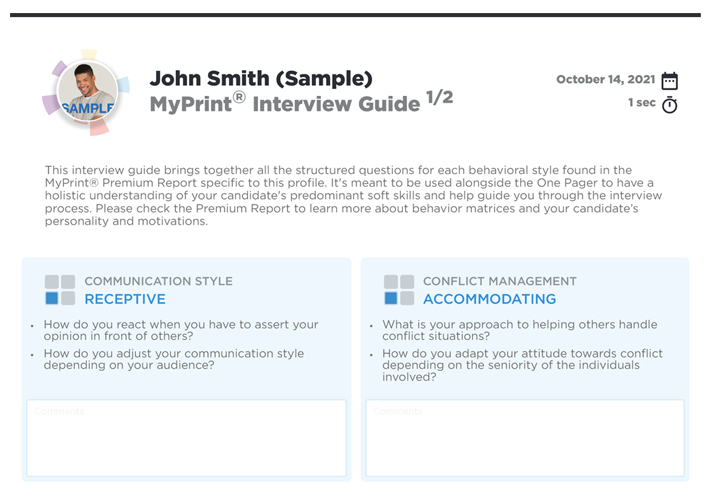
Talentobe’s Interview Guide is generated based on an individual’s MyPrint results. After a job candidate completes their soft skills assessment, hiring managers can now access sample interview questions based on behavioral work styles, including:
- Learning Style
- Conflict Management
- Communication
- Decision Making
- Work Style
- Leadership Style
- Creativity
- Risk Orientation
- Team Participation
- Change Reaction
- Rule Consciousness
In short, our Interview Guide brings together key structured questions for all of the behavioral styles found in the MyPrint results specific to a candidate's profile in one easy-to-use format.
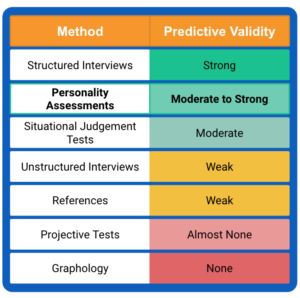 When coupled with a soft skills assessment that’s backed by the science of people analytics, structured interviews have proven to be one of the best predictors of future work performance. A clearly defined structured interview process also ensures that the candidate experience remains consistent and unbiased.
How to Use the Interview Guide
This guide is meant to be used alongside the MyPrint One Pager report in order to provide holistic understanding of a candidate's predominant soft skills and help to inform the interview process.
The sample questions provided allow hiring managers to go above and beyond the analysis of the soft skills results in order to zero in on behavioral takeaways. They can help interviews to identify the behaviors that are most relevant to the job description, then support the process of asking for relevant and concrete examples from previous professional experiences. The questions generated in the Interview Guide can be used both in behavioral and structured interview designs.
It’s important to note that the results provided for each candidate should not be utilized as a coaching tool; it is not for those being evaluated, but for the evaluator! Whether being used to gain insight during recruiting interviews or to support development during the annual review process, the interview guide acts as a tool to support decision making driven by the science of soft skills.
Ready to Get Started?
If you’re ready to gain a deeper understanding of your job candidates and improve decision making by asking the right questions, click here to learn more about Talentobe’s Interview Guide. Then, experience Talentobe’s people analytics for yourself by signing up for a free trial.
Welcome to MyPrint: Understanding Your Soft Skills Assessment
The digital world is full of people creating an online persona to market themselves to others in a certain way. Between social media filters, staged photos, and selective sharing of information, what you see is not always the most accurate representation of what a person is truly like. It can be hard to discover your true, unique self, let alone share it with others! That's where utilizing a scientifically-based soft skills assessment can help.
Why are soft skills important?
Here at Talentobe, we love to say that, “Hard skills will get you a job, but your soft skills are what make you great at your job.” Simply said, hard skills are important to get where you want to be in life; earning a degree or certification, gaining work experience, and having the basic knowledge for a position are essential. However, soft skills are the things that will set you apart. How you interact with others, the way you organize yourself and prioritize your work, and being able to adapt to your environment are all examples of soft skills that can lead to career success.
What is MyPrint?
MyPrint is Talentobe’s soft skills assessment that is designed to dive into the personality, motivations, and behaviors that make you unique. The questions are all geared towards the workplace to help you get a better understanding of your soft skills in a professional context.
MyPrint consists of 13 personality dimensions, 11 motivation dimensions, and 11 professional behaviors. The personality and motivation dimensions each have two ends of the scale, called poles, which leads to an output of 26 possible personality traits and 22 different motivators. Each of the professional behaviors has 4 possible styles, leading to information on 44 different behavioral styles. If you’re trying to figure out how many unique results that leads to, we did the math for you: there are over 70.3 trillion possible MyPrint combinations (70,368,744,177,664 to be exact!)
How do I take a MyPrint?
Taking a MyPrint is easier than ever! Simply click here to be taken directly to the registration page. The assessment is free to take, and upon completion you will be able to see your Personality Radar in the application, and your MyPrint One Pager will be available to download.
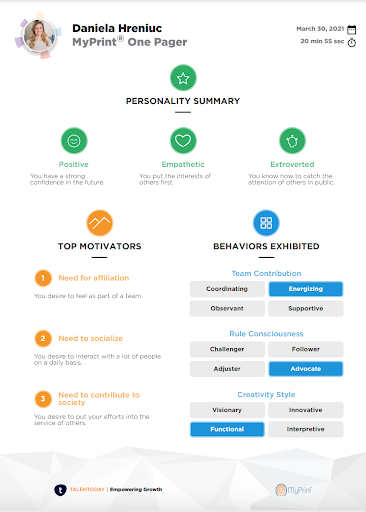
After you have taken some time to view your results, share them! You have the option to share your MyPrint results to multiple social media channels, including LinkedIn, Twitter, and Facebook.
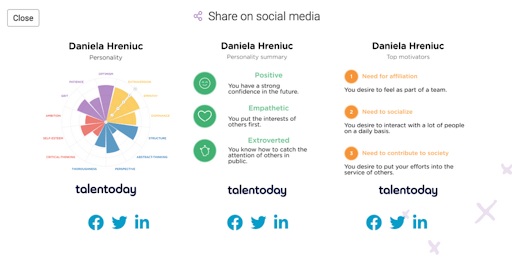
The next time you are looking for a new position, or even looking for more responsibilities or a promotion from your current role, make sure you highlight your soft skills! Use your MyPrint to help showcase the soft skill strengths that make you unique!
Want to learn more about what makes you unique? Visit our website talentoday.com and take a MyPrint assessment today!

Rethinking Retention and Reining in the Great Resignation
If you’re an HR professional, you are well aware of the stats by now. A majority of employees (65 percent, according to PwC) are on record saying that they are at least entertaining the idea of leaving their workplace for a new job. This August, a record 4.3 million workers actually took the leap and quit their jobs. In short, businesses in all industries are facing an employee retention crisis.
The question is no longer, “Is the Great Resignation really happening?” In the wake of the effects of COVID-19 and the economic uncertainty that has come with it, the U.S. workforce has answered that question with a resounding, “Yes!” For organizations looking to stabilize their teams, the billion dollar question now is, “How do we rein in our great resignation with a healthy dose of great retention?”
One thing is clear: The old ideas for keeping employees engaged and employed simply are not cutting it anymore. Thankfully, three building blocks for rethinking retention - identifying what makes your situation unique, reevaluating career paths and getting creative - provide a starting point for leaders in need of continuity in their workforce.
Identify What Makes Your Situation Unique
The Great Resignation may be a catchy name, but lumping together millions of life-altering career decisions into one neat package can be misleading. Buried within the shocking statistics and clickable headlines are millions of individual personalities, motivations and behaviors driving these choices. The reasons for increased turnover can vary widely from company to company, team to team and person to person. Therefore, it’s important to zero-in on what makes your situation unique.
Employing quick-fix solutions, like increasing compensation for particular high-turnover roles, may be tempting, but can also prove to be short-lived in effectiveness. Instead, consider utilizing company-wide surveying and soft skill assessments. These scientific tools can give leaders measurable insight into what’s driving change, as well as what might be more likely to encourage employees at a team and individual level. After all, if the factors driving employees to leave aren’t one-size-fits-all, why would a single solution get retention back on track?
Reevaluate Career Paths in a Changing Workplace
A recent survey commissioned by The Conference Board revealed that 58 percent of talent acquisition and HR leaders report that their employees are concerned about upward mobility if they are not physically in the workplace. These results highlight that the disconnect from the shift to remote and hybrid workplaces runs much deeper than missing out on water cooler conversations; employees are increasingly losing a grasp on the opportunities for growth available to them within their organizations. If employees cannot see a future for themselves where they’re currently at, it stands to reason that they’d look elsewhere for fulfillment.
How can companies counteract resignations stemming from this disconnect? The report goes on to recommend that organizations reward leaders for facilitating internal movement of employees, develop a cross-functional talent mobility program and find ways to give virtual employees added exposure to these opportunities for mobility. The motivations that drive an individual’s career decisions naturally change overtime. For better or worse, the COVID-19 pandemic has accelerated these changes for many people. Before losing talent to greener pastures elsewhere, leaders need to provide their employees with opportunities for upskilling, growth and lateral moves internally.
Get Creative Early and Often
When an employee decides it’s time to move on, there are plenty of options available to organizations trying to find ways to keep the talent in-house. While money can be enticing for many employees, it’s not a panacea (and some organizations simply cannot withstand a counter-offer war for top talent given their current financial situation.) It’s time for companies to become creative when finding ways to retain employees. Using people analytics derived from surveying and soft skills assessments, HR professionals can better identify incentives that are personalized to the individual. For example, while an increased annual salary might be a key driver for one employee, more flexibility in scheduling and work environment might rank higher for another.
However, one major takeaway for the HR Community in light of the Great Resignation should be that preventative measures need to be taken before workers begin to leave en masse. Let your creativity shine long before it needs to be used in a last-ditch effort to hold onto employees! According to Inc.com, some CEOs have begun relying on exercises such as “anything but work” check-ins, gratitude sharing sessions and games to connect with employees on a personal level in the era of hybrid work.
Will these efforts help boost your organization’s employee retention in the face of the Great Resignation? The only way to know is by building personalized solutions tailored to the needs of each employee. Otherwise, you'll be resigned to riding a rising tide of turnover.
Are you ready to identify what motivates your candidates and employees? Experience how MyPrint can uncover a better way to hire and retain a top team by clicking here!

How Soft Skills Can Help Students Choose a Major
Making the decision to continue on with your education is a big investment, no matter who you are or what level of education you are pursuing. Even if you are one of the lucky students whose tuition is paid for based on your geographic location or scholarships, the time and work that goes into a successful college career is something that should not be taken lightly.
According to the US Department of Education, 30 percent of students switch majors at least once. Switching majors can be costly and time consuming, so before you just jump into the major that is projected to lead to the highest paying job, here are four steps you can take to make sure it’s the path that is right for you.
Determine which soft skills you already have.
There are so many majors out there that it can be hard to narrow it down. A good place to start is with some self-reflection. Since college is the place to go for the hard skills you will need in your career, one of the best ways to make sure you are choosing the right educational path is to be equipped with the soft skills needed for success.
A good place to start is by thinking of the skills that have made you successful in your previous work and educational experiences. Were you always the organized one in group projects? Maybe your communication skills and patience have helped you in jobs like retail or the service industry. Even the ability to juggle multiple tasks at once can be a key skill that you are already equipped with. Your hard skills will get you the job you are looking for, but those soft skills are what will make you successful in that position.
Which careers need your soft skills?
Once you have taken some time to determine the soft skills that you already possess, a great next step is to find a field or career path that requires those skills. Lucky for you, we have already done some research on this topic at Talentobe! Assessment results from our user database have revealed that there are a lot of soft skills that are transferable across multiple fields. Rather than feeling like your soft skills are narrowing out possibilities, think of them as guiding you in a direction that you will have a natural inclination towards!
Fill in those gaps!
Continuing your education is the time to gain the missing hard skills for your future career, but it’s not too late to develop your soft skills as well. People are dynamic and capable of growth in so many areas of our lives, and your soft skills are no different!
There are a lot of ways that you can work to fill in your soft skill gaps. Being aware of the skills that you want to improve or develop can help you be conscientious about working on those skills. You can also use college to your advantage! Most universities, junior colleges, and online programs offer classes on a variety of topics. Work with an advisor to choose courses that challenge you, rather than opting for ones that already play to your strengths. For example, if you have a knack for research, but have a fear of public speaking, a communication class might be a good fit to begin expanding your soft skills palette.
Take your time.
Lastly, take your time. Although it seems like you need to declare your major immediately, it is okay to do things at your own pace. Most universities will require you to start by taking some general classes of interest before you jump into your declared major. There is no “right” timeline for a decision like this, and it is better to take some time on the front end to make the most of your investment!
Interested in learning more about what soft skills make you unique? Click here to take a MyPrint assessment today!

Understanding the Difference Between Intrinsic and Extrinsic Motivations
When it comes to motivating employees, one size does not fit all. For some people, the thrill of competition for hitting or exceeding key metrics, like number of sales per quarter, gets them excited. For others, discovering the best way to complete a given task, such as finding the most efficient solution for cold calling, might be a source of inspiration. No matter how it happens, employers recognize that maintaining employee motivation is key for sustaining success - especially in hybrid and remote work environments.
Before launching new programs aimed at motivating a workforce, it’s important to first understand the nature and types of motivations that exist. Then, tailor those available options to meet the unique needs of each employee.
Why is Motivation Essential?
Obviously, employing and supporting a motivated workforce should be a priority for all organizations. However, the effects of the COVID-19 pandemic have shown us just how valuable it is to have a varied approach to motivation.
For example, a recent survey from Jostle of 400 employees who shifted to remote work in the past year revealed that a whopping 83 percent of individuals reported feeling disconnected from their workplace culture. While productivity may not have dipped in the short term, the fact that a majority of respondents also noted feeling less supported by managers during this time makes it clear that these results in output are not sustainable over the long-term.
As the way we work changes, so too must the way that managers motivate their teams. As organizations embrace a hybrid approach to work, combining virtual and in-person elements, it’s time to look at motivational practices in the same way.
To get to the heart of the motivation question, here is the first question every manager must ask: Are my employees driven by intrinsic or extrinsic motivations?
Intrinsic or Extrinsic Motivations
To start, the concept of separating out intrinsic and extrinsic motivations is a fairly straightforward - yet essential - exercise. According to Psychology Today, “intrinsic motivation refers to those activities you do because you enjoy the activity itself,” whereas extrinsic motivations refer to anything we do because of reasons outside of the work. Extrinsic motivators include salary, job perks/benefits, status and work conditions. Intrinsic motivators include things like recognition, challenging work, purposeful work, achievement and opportunities for personal growth.
Consider the examples mentioned at the start of this piece. A sales team competing for top spot on the quarterly metrics tracker would be a textbook example of an extrinsic motivation. Even though making sales might be related to the job at hand, taking first place in this competition is a motivation tied to results, not the tasks of the job itself. On the other hand, an employee might find joy in the actual process of selling. For example, the step-by-step journey of finding the best times to make outreach and most effective scripts might be exciting in its own right.
For those motivated intrinsically or extrinsically, there are a variety of ways employers can meet their needs with tailored solutions. Here are the forms of intrinsic and extrinsic motivations identified by the MyPrint soft skills assessment:
Intrinsic
- Responsibility: This motivation dimension refers to the extent that a person seeks to feel accountable. While some individuals find joy in making big decisions for their teams, others would like to share that responsibility with others.
- Influence: This motivation dimension refers to the extent that a person seeks to influence others’ opinions and intentions. Those that are highly motivated by influence enjoy swaying others’ opinions, while those that are lower on this motivation dimension are happiest when they can stay open-minded to different points of view.
- Belonging: This motivation dimension refers to the extent to which a person wishes to be part of a group. Individuals who are highly motivated by belonging seek to find common interests and hobbies with their coworkers to create a team feeling, whereas other individuals like to keep their interests or opinions independent from the rest of the group.
- Challenge: This motivation dimension refers to the extent that a person seeks to get out of their comfort zone. Those that are highly motivated by challenge will always try to outperform their previous goals and achievements, whereas those that are not as motivated by challenge are content working towards attainable goals.
- Recognition (Intrinsic enjoyment): Those that are on the lower end of the recognition dimension are seeking intrinsic enjoyment. They seek out projects and tasks that they enjoy doing, even if they are not receiving any external recognition for their work.
- Reward (Need to contribute to society): Those that are on the lower end of the reward dimension seek to work on projects that have an impact on society. They need to understand the greater impact of their work, regardless of the tangible benefits they might receive.
Extrinsic
- Autonomy: This motivation dimension refers to the extent to which one wishes to control their circumstances. Those that are highly motivated by autonomy like to set their own goals and schedule, whereas those who are lower on the autonomy dimension prefer to consult with others before setting their goals.
- Competition: This motivation dimension refers to the extent that an individual will seek to outperform others. Those that are highly motivated by competition like environments that encourage public performance metrics, whereas those that are lower on the competition scale will seek to share their knowledge to help work towards group goals.
- Relation: This motivation dimension refers to the extent to which an individual seeks to have multiple social contacts. Those that are high on this motivation dimension seek out opportunities to socialize as frequently as they can, whereas those who are lower on this dimension desire privacy in their work environment.
- Recognition (External acknowledgement): Those who are high on the recognition dimension seek positive feedback and compliments for a job well done. The external recognition is enough to keep them motivated, even if they do not necessarily enjoy the work they are doing.
- Reward (Tangible benefits): Those who are high on the reward dimension are motivated by having their performance rewarded by material benefits. They will often be encouraged to work harder when there are opportunities available.
- Excitement: This motivation dimension refers to the extent to which an individual is motivated by thrill. Those who are highly motivated by unpredictable environments and the opportunity to take risks, whereas those on the lower end of the excitement dimension prefer safe and predictable environments.
- Variety: This motivation dimension refers to the extent to which an individual seeks out new experiences. While some individuals seek out diverse experiences, projects, and skills, others prefer to stick to familiar routines and work methods.
Motivating and Moving Forward
Gone are the days of ordering pizza into the office to celebrate a job well done and calling it a day. In the changing world of work, managers need to become more nuanced in the ways they motivate employees. To start reshaping these practices on a case-by-case basis, it’s important to identify whether an individual is driven by intrinsic or extrinsic motivations. Only then can managers determine which particular path is right for each employee.
Are you ready to identify what motivates your employees? Experience how MyPrint can uncover what makes you and your team unique by clicking here!