


In Pursuit of Happiness: My Lesson in the Importance of Measuring Motivation
For as long as I can remember, I have had an insatiable urge to maximize my potential for achieving a meaningful and happy life. My mom will recount stories of gritting through the parent-teacher conferences of my adolescence with my teachers cautioning her to put “less pressure” on me due to the intensity I brought to spelling tests and class projects. My mom would assure them that there was no pressure; it was all driven by a little fourth grader with an intense motivation for personal achievement.
Over the years, the devotion to fulfillment of potential never waned. I found myself driven by achievement, influence and responsibility, and I had successfully scouted out professional and educational opportunities to satisfy that. However, I approached a pivotal point in my personal growth when I was by all appearances in the prime of my career, building a life in the United States with a wonderful partner and our loving, loyal pets, leading teams of brilliant people while also pursuing a graduate degree to deepen my business acumen. Yet, somehow, something was missing. As I reached a point along the path I had been going down for years that was supposed to open me up to more in life - more opportunities, more success, more joy, it hit me.
I had been misdiagnosing my motivation. Somehow during the years of chasing personal achievement, my motivational needs evolved. With unique perspectives and education in my toolkit, my new driving force was combating complacency, seeking out new challenges and adventures. My previous solutions for happiness and fulfillment were no longer going to suffice. The cure was taking a hard look at not only who I was, but who I had become, and who I might become next, to truly identify the drivers and motivations that would lead me to a content and happy life.
Defining Motivation
Motivations are often defined as the desires and needs that help determine how an individual behaves. Examples of motivations can include external things, like receiving recognition for your work, or internal factors, such as working on projects that challenge you. When these different needs are met, we become more engaged. This leads to more energy, commitment and creativity, as well as higher levels of productivity and satisfaction.
Motivation is most often discussed in professional settings, and with good reason; companies are always searching for new ways to encourage their employees to achieve more. However, recent research from Gallup indicates that about 80 percent of the global workforce is not engaged in their work. The cost of this mass malaise goes well beyond dollars and cents, with effects that touch our lives outside of the workplace, as well.

Motivations Mean Something Different for Each of Us
In the spring of 2019, I had just finished earning my executive MBA and was ready for a new challenge. After more than a decade spent building my reputation as a detail-oriented marketing professional, I needed to add some variety and excitement to my career. The previous summer, Medix, the U.S.-based workforce solutions company I had spent my entire career with up until that point, had acquired Talentobe, a science-driven people analytics company headquartered in Paris, France. It was a bold step forward for a company I thought I knew like the back of my hand. Was this new opportunity the spark I had been searching for? Ready to take on a new adventure, my husband and I packed up our bags and our pets and made the move from Chicago, Illinois to Paris.
Throwing caution to the wind to cross the Atlantic was energizing and fulfilling for my need for personal challenge. Working with individuals who had different backgrounds than my own and taking on obstacles that I had never faced was by definition challenging, but thrilling at the same time.
At that time, I also came to the realization that this wouldn’t have been the case for everyone in this same scenario. Another professional who was instead motivated by consistency in procedures, attainable goals or predictable environments might have struggled with such a dramatic career change. To me, the lesson was clear. If most companies give employees frequent recognition, bonuses or other types of incentives, then why are the majority of us not engaged at work? This is where things get personal. In order to properly motivate someone, you need to know what it is that inspires them!
Share Your Motivations!
Whether you are setting professional or personal goals, there are the standard questions that are covered on a regular basis. How much do I need to earn to live comfortably? How hard do I need to train to hit my fitness goals? What’s my five-year plan?
Unfortunately, we very rarely ask ourselves direct questions about whether we are feeling fulfilled and, if not, what the factors are that are discouraging us. Only after identifying our core motivations can we turn this attention outward in order to inspire and encourage those around us.
Being transparent about our differences in motivations is an essential first step to better engaging with those around you on their own terms. Sharing individual needs and making that a regular part of the conversation is going to not only help your colleagues and loved ones feel seen and heard, but it’s a practice that promotes wellbeing in every facet of life.
People Change, and So Do Motivations
When I first moved to Paris, I was invigorated by my new environment. I was taking on a new industry in a new country with a new team. However, within a few months, I started to experience that feeling again that something was missing, that something was holding me back from true happiness. I knew I couldn’t give my best effort to those counting on me without figuring out what needs weren’t being met to ensure personal fulfillment.
Working at Talentobe, I thankfully was surrounded by resources dedicated precisely to this mission. I had access to an assessment built on the science of psychometrics designed to unearth insights on your personality, motivations and behaviors as an individual. When I had first stepped into my new role, I had taken the assessment to get a better sense of our product offering. To my surprise, I actually ended up learning a lot about myself along the way. After retaking it, I learned something new - people change, and so do our motivations.
While I was once motivated by change, my heart and science were telling me these needs had evolved. With a major life and career shift satisfying my previous need for challenge and excitement, my need for a sense of belonging grew. When I was back home in the U.S., it was effortless for me to pick up the phone to check in with my mom or grab lunch with a friend. Now, with an ocean between us, that was no longer possible. Once I realized what was missing for me in France, I focused on creating that sense of family I was longing for with my new teammates and put more effort into regularly keeping in touch with my loved ones back home.
Human beings are constantly evolving with their environment, and the same goes for our motivations. This is why it is important to continuously check in with ourselves, the people we work with and those who are with us at our most vulnerable moments to ensure that we are adjusting along with these evolutions. Changes in perspective can also lead to changes in priorities. Once you’re cognizant of this and make a point of keeping your finger on the pulse of these motivations, you’ll be more successful in regulating your environment, activities and life to achieve true happiness and fulfillment.
This article originally appeared on the Bonjour Sophy blog. Bonjour Sophy, a Talentobe partner, is a program that helps individuals discover their life mission. Learn more by clicking here.


Unpacking Your Personality: How Do You Address Tasks and Projects?
Even if you think that you know a lot about yourself and your personality, it is always good to be open to an unbiased opinion about how you respond to the world around you. This can include how you interact with others in class or during meetings, the way you handle pressure of deadlines or tests, and how you organize projects. Taking a personality or soft skills assessment, like MyPrint, can help to uncover strengths you were unaware of or reinforce what you already knew.
What are your strengths and how do you use them on a daily basis? Are there any skills that you are missing or want to improve upon? These are just a couple of the questions that you can ask yourself to get the most out of your soft skills assessment results.
Understand how you approach tasks and projects.
Personality and soft skill assessments help us understand ourselves better by using basic psychological models, such as the Big Five Model of personality. At Talentobe, we have organized our personality dimensions into four groups, called the personality axes, to show how understanding your different traits will empower you to navigate your day-to-day life using science and technology. The four personality axes in MyPrint help us understand how we interact with other people (“Express” - yellow), our tasks and projects (“Address” - blue), ourselves (“Dare” - red), and our environment (“Adapt” - purple).
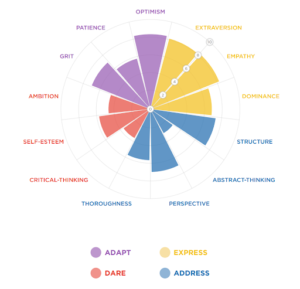
The Address section of the personality axes is helpful for understanding the way someone approaches issues and undertakes their tasks or projects. This can be beneficial when starting a fresh school year or new job, or if you’re just generally interested in making meaningful improvements in your day-to-day responsibilities.
The four personality dimensions that make up the Address axis are: Structure, Abstract-Thinking, Perspective, and Thoroughness. Being on the high or low end of each of these dimensions does not make you better or worse at planning or conducting your tasks; rather, it helps you to understand your strength in each of those areas so that you can lean into the things you are good at, while pinpointing the areas in which you may want to improve. Remember, you can always leverage an assessment to help understand your personality with an unbiased, scientific approach.
Structure
The two ends of the structure dimension are Spontaneous and Orderly.
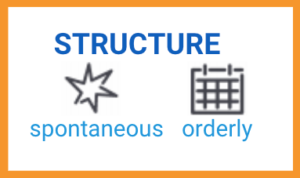
If you are a spontaneous person, then you are naturally intuitive. You like to stay flexible in your schedule by avoiding planning things too far in advance, and you often leave a lot of room for improvisation in your working methods. If you are finding that you need a little bit more structure when organizing your week, start by writing down your most important objectives, and do your best to accomplish those even if other things come your way.
On the other end of the structure dimension are the orderly people. If you are orderly, then you are very organized and show no tolerance of ambiguity in your work. You always plan your tasks and projects well in advance and rarely deviate from your schedule. Although this may seem like it is the best way to organize and plan, there are certain times when flexibility is beneficial. When creating your to-do list, determine what is an absolute priority and what you can be flexible with; stay open to opportunities that may come your way.
Abstract-Thinking
The two ends of the abstract-thinking dimension are Practical and Imaginative.
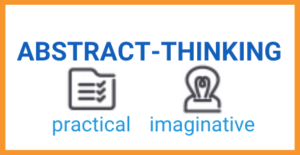
If you are a practical person, you are realistic and don’t like to waste too much time wondering why things are the way they are. You rely on concrete examples to solve issues. If you find yourself stuck when working on an assignment, try to tap into your imagination a little bit. Think of some out-of-the-box ideas for your projects that you might not normally entertain.
On the other end of the abstract-thinking dimension are the imaginative people. If you are imaginative, you often conceptualize problems and try different approaches in order to solve them in the most relevant, but not always the most realistic way. Imaginative people are very creative, but if you find yourself unable to solve an issue, try to only look at what resources and solutions that you actually have available.
Perspective
The two ends of the perspective dimension are Focused and Big Picture.
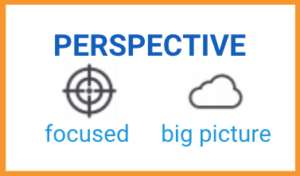
If you are a focused person, then you are action-oriented. You probably prefer to concentrate on achieving short-term results, rather than spending time to anticipate their future implications. While it is beneficial to focus on those immediate outcomes, there is also a lot to be learned when looking at the long-term impacts of what you are doing. When learning something new or working on a project, think about the relevance and meaning it will have a few years into the future.
The other end of the perspective scale is where the big picture thinkers are. If you are big pictured, you are naturally thoughtful in your work. You will anticipate the long-term consequences of what you are doing as much as possible to have a clear vision of the final outcomes. At times it can be exhausting to think about the future when there is so much uncertainty. If you find yourself being overwhelmed by this, try to focus on the pieces of a project that you can immediately impact regardless of their long-term implications.
Thoroughness
The two ends of the thoroughness dimension are Easy-Going and Precise.
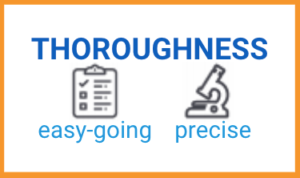
If you are an easy-going person, you are typically tolerant of imperfections. You prefer to value your productivity at work by focusing on the bottom-line, rather than dwelling on every little detail. Having a quantity-centered approach to your work can be beneficial at times, but it is always good to be cognizant of which projects might require a little more attention to detail. When these types of projects come up, schedule some extra review time into the end of your day!
On the other end of the thoroughness dimension we have the precise folks. If you are a precise person, you are naturally diligent. You set high-quality standards for your work and spend time to refine it. However, sometimes it is hard to turn off the ‘perfectionist’ switch. Determine which areas of your work need the extra attention to details, and try to only spend the necessary time on the rest.
Putting it all into action.
Now that you know a little more about the personality traits used to understand how you take on tasks and projects, as part of MyPrint’s Address dimension, it is time for you to take action. If you haven’t taken a MyPrint just yet, you can take it for free in just 25 minutes! There are many other helpful insights besides the ones we discussed here, such as what motivates you, or getting a better understanding of your professional behaviors. Take a look at which soft skill strengths you have and what motivates you, and use that information to help you improve as you take on your next project!

Why Upskilling is Crucial for Hybrid Teams
There were a lot of things I didn’t know I could do before COVID-19 upended the way we live and work. For example, I already knew my way around the kitchen, but I had no idea I could make tasty banana bread! I also learned how to cook a spicy jambalaya, brew my own beer and, when I wasn’t eating or drinking, I figured out how to use a 35mm film camera to expand upon my interest in photography. In my home life, I would call these achievements “little victories.” Little did I know that, were I to do the same sort of expanding of my talents in the workplace, it would be known as “upskilling.”
Upskilling is the process of using training and education to deepen an employees’ abilities within their area of expertise. This is slightly different from reskilling, which is when an employee is trained on an entirely new skill set in order to move into a different role. Instead, upskilling is all about building upon an employee’s existing skills in hopes of enhancing their impact on an organization.
While my personal upskilling may not have major implications for the workplace (even if some morning meetings are greatly improved by the addition of banana bread), upskilling has the potential to reshape the way organizations recruit and develop talent – especially as teams embrace hybrid work models.
The Skills Gap Continues to Expand
As the modern workplace undergoes unprecedented changes, existing skills gaps across all industries are widening. While employees may have entered into the workforce with skills that were in high demand at the time, the rate of digital transformation has increased sharply in response to the COVID-19 pandemic, leaving many of these employees behind. According to McKinsey & Company, 87 percent of companies say they have skills gaps or expect to within a few years. Jobs are changing fast, and employers and employees are struggling to keep up.
There are a few options at organizations’ disposal for dealing with these gaps in needed competencies. In less competitive hiring markets, one appealing course of action would be to bring in new talent to fit the needs. However, today’s recruiting landscape is characterized by a dwindling supply of talent and an aggressive influx of demand from employers. These conditions have forced many employers to look inwards when determining how to address their skills gaps in the years ahead.
Employees are Looking for a Change
To exacerbate the problem even further, this expanding skills gap comes at a time when workers are beginning to quit jobs at extraordinary levels. In April 2021, the number of employees leaving their companies spiked to approximately 4 million according to the Bureau of Labor Statistics (BLS), leading many to refer to the phenomenon as, “The Great Resignation.”
In truth, does anyone ever really want to be forced to find a new job? In the same way that employers would rather retain talent than search for replacements, employees are hoping for reasons to stay at their current organizations before making a drastic move. Take the results of a recent PwC survey into consideration. Their findings show that the majority of workers are open to change, citing that 40 percent of respondents successfully improved their digital skills during the pandemic and over 90 percent of those who adapted to remote work would prefer to continue working in this style of environment. On top of that, 77 percent of workers are ready to learn new skills.
The issue is not a lack of willingness to learn on the side of employees but, rather, the lack of opportunities for upskilling offered by employers. However, if organizations are serious about closing their skills gap and retaining employees in the face of an explosion of resignations, it’s time to make learning and development programs a real priority.
Make Upskilling a Priority
While employers seem to recognize the problem they face, there remains a gap between this recognition and an understanding of how to address the underlying causes. According to a 2021 survey conducted by Gartner, 68 percent of HR leaders cited building critical skills as a top priority. However, more than 30 percent of the same leaders say that they don’t know what skills gap their employees have, how to effectively integrate learning into employee workflows or can’t create skill development solutions fast enough to meet evolving skill needs. In short, employers know there are skills gaps to address, but are uncertain where they lie or how to fix them.
The way forward is two-pronged, based first on assessment then solidified with commitment:
- Assessment: First and foremost, organizations need to utilize tools to empower them to better evaluate their candidates and employees. Knowing the current capabilities of a team is important, but identifying the potential for growth can be critical. While necessary technical skills can be assessed through traditional means, such as verifying education and certification backgrounds, this must be coupled with a deeper understanding of soft skills. Scientifically-based soft skills assessments can provide insight into an individual’s capacity to upskill into a role over time.
- Commitment: Once the workforce has been properly assessed, organizations must then approach upskilling differently than standard onboarding and other job-specific training opportunities. Instead, upskilling opportunities must be treated like the valuable benefits they are. As noted in Fast Company, “For the top tier of talent, upskilling is emerging as a must-have employee benefit, like a retirement saving plan, employer subsidized health care, or paid time off.” In other words, these education programs cannot be haphazardly inserted into existing workflows. Rather, time and space must be set aside for employees to truly feel as though upskilling is a top priority.
As the way we work continues to change, teams are struggling to keep up. However, by devoting time and effort to upskilling programs, there are win-win solutions available for employers and employees alike.
Are you ready to evaluate your team’s soft skills to determine upskilling opportunities? Discover the powerful science of people analytics that drives MyPrint by clicking here.

Letting Your Personality Shine in a Remote Work World
How do you remain unique in a remote work world? In the pre-pandemic workplace, many of us may have taken the casual ways of letting our personalities shine at work for granted. You probably didn’t even think twice about it as it happened! Maybe you were the social butterfly stopping by multiple desks en route to your own. Maybe you were the ‘first in and last to leave’ person who was always striving for the next career opportunity. Whatever style you worked with, there were little moments each day to bring your identity to life.
Now, the expansion of work from home opportunities has changed the ways we interact. How do you show who you truly are through small screens connected by the internet?
Although it requires more work to let your personality shine in a remote environment, technology has made the transition a little less painful. They may not be the same as those face-to-face interactions, but our virtual personalities are just as important!
Make meetings work for you.
Meetings have not disappeared from office culture in the last year, but they certainly have evolved. Video calls underwent an unprecedented expansion during the COVID-19 pandemic, For example, Zoom reported growing from 10 million peak daily meeting participants in 2019 to 300 million by April 2020. While virtual meeting tools may have helped to keep teams connected during this time, the repeated virtual interactions on screen can take a toll even on the most outgoing of people. Is it any shock that ‘Zoom fatigue’ quickly became a part of our vernacular?
These countless virtual meetings present new challenges, including finding ways to you distinguish yourself from the faces staring back at you from the video grid. If you are a social person, try logging in a minute before the meeting starts. This way you can greet people with some small talk as they join in the meeting. For our curious individuals out there who like to learn new things or ask a lot of questions, if the virtual meeting doesn’t allow for your normal cadence, take notes with your thoughts and questions and send them to the meeting host in an email at the end of the call. For our introverted folks, it’s always okay to turn the camera off and stay muted every now and then.
In other words, make these video meetings work for you!
We are used to adapting to multiple personality types in a conference room, so this adjustment to accommodating multiple personalities in the virtual space is something we are all learning together. If you find yourself in a position where this format is hindering your work performance or wellbeing, talk with your manager or HR department to discuss potential adjustments.
Email is still essential.
Email may not have ever been the working world's favorite way to communicate, but at least there were opportunities to smooth out unclear communication and tension face-to-face in the office. Now, our virtual communication is often lacking that in-person context or interaction, and we find ourselves communicating complex messages via text alone.
If you are a straightforward or direct communicator, your emails might come across as being abrasive if you don’t have the ability to smile at the recipients as you pass each other in the hallway later that day. In this situation, you would want to make sure that you include some warm greetings or salutations to your emails.
Are you or someone you know an "email blackhole?" This phenomenon can be described as an inbox where messages are sent, but no replies ever return. If this sounds like you, it may be time to reconsider your approach to email! In a physical work environment, a lack of responsiveness could be a minor annoyance. However, when your coworkers are dependent on emails as a main form of communication, you might need to shift your email personality to being quicker with follow-up.
While email has long been the go-to virtual setting for sharing our work personalities, it’s only becoming more essential as teams embrace hybrid and remote settings. Before sending that next message, take a moment to consider how to personalize your text communications.
Be transparent.
The most important aspect of any relationship or work environment is transparency. Although you might need to work a little bit harder to let your personality come through in a virtual space, stay true to your authentic self. Check in with yourself regularly, and communicate with your boss or coworkers if you feel as though your personality strengths or motivations are not being used or met. By doing this, you will allow yourself to not only be fulfilled in your work, but also help to form an environment that you can perform the most effectively in.
Rethink your office culture.
Historically, office culture has started in the physical environment. We create a ‘second family’ at work by getting to know our coworkers through team building activities or simply chatting over a cup of coffee. As offices continue to embrace hybrid and remote work models, the idea of building culture on the basis of these social interactions alone may be on the way out,
Now more than ever, the organizational culture you are a part of has the ability to develop and grow in any direction you choose. Take this opportunity to really understand your personality strengths and what motivates you, and curate a culture with your virtual team to ensure you are and finding purpose in your work!
Want to learn more about your personality strengths and workplace motivators? Click here to take a MyPrint!

How Culture Add Goes Beyond Culture Fit to Support Diversity, Equity and Inclusion in the Workplace
For years now, organizations have been stressing the importance of using company culture to drive recruitment and team management efforts. The theory being that hiring individuals that align with the elements that make up a company’s culture - like preferred work environment, company mission, leadership style, values, ethics, expectations and goals - will lead to a happier, more productive workforce.
It’s why most HR professionals have seen (or have had a hand in crafting) recruiting pitches like these:
“Be a part of a fast-paced team!”
“Join our values-driven organization!”
“Are you looking to work in a collaborative and creative environment? Apply now!”
While these culture-driven hiring efforts may be well meaning, there’s growing research indicating that making decisions based on “culture fit” alone may be missing a bigger point. Instead, the real key to unlocking a productive and diverse workforce may be what’s known as “culture add.”
What is Culture Fit?
To begin, hiring professionals need to assess how the industry has been operating in order to determine the best path forward. When culture fit first gained momentum in offices, the idea seemed both groundbreaking and simple. Instead of only relying on hard skills and job description qualifications when determining the best possible fit for a role, HR teams decided to go further. Now, how people go about their work was just as important as what they were doing. Since the style and approach required for being successful at one organization may not transfer to another, culture fit aims to assess whether a candidate’s attitude, motivation and values are aligned with the culture.
Where Does Culture Fit Fall Short?
Unfortunately, hiring for culture fit does not always add up to the ideal workforce its proponents claim to deliver. While the attention this methodology brought to historically under-evaluated areas of candidate profiles, such as personality, motivations and behaviors, was an improvement, it also led many hiring managers into a dangerous trap known as affinity bias. According to LinkedIn, “Affinity bias is the tendency to have a preference to people like ourselves. In hiring, affinity bias can mean leaning toward one candidate over another because they have a relatable background, belief, or appearance.” In other words, while organizations may have thought they were hiring the best candidates for the job thanks to how well they “fit” into a culture, they may have unknowingly been building a homogenous workforce lacking in true diversity. This same research goes on to note that inclusive companies are nearly two times more likely to be innovation leaders in their market, and these same companies outperform industry norms by an average of 35 percent.
Clearly, while hiring for culture fit can have its benefits, companies that do so may be leaving countless amazing hires behind due to rigid match criteria.
How is Culture Add Different?
Today, the practice of hiring for culture add aims to improve where culture fit strategies fall short. As a recent article in Fast Company puts it,” Assessing for culture fit can unintentionally encourage managers to pick candidates that look like everyone else. But looking for culture add helps managers to determine how a candidate’s individuality and differences can make a company better and stronger.” Rather than stifling the things that make a candidate unique, culture add aims to find ways to embrace that individuality within the existing framework of a company’s culture.
In truth, getting to this point can be challenging - especially for larger organizations with deeply ingrained cultures and hiring processes. Culture change takes time, and there needs to be top-to-bottom buy-in to ensure everyone moves in the right direction to embrace diversity, equity and inclusion at scale. LaFawn Davis, Vice President of Diversity, Inclusion and Belonging at Indeed.com, offers these best practices for companies looking to move towards culture add-based hiring:
- Empower recruiters to push back. When culture fit is given as the reason to decline an offer, recruiters should be able to ask follow-up questions to ensure this reasoning is not being used as an excuse to make decisions based on bias or emotion.
- Ask for more details. Sparking a deeper conversation about a hiring manager’s desired attributes and skills, and how the candidate may meet or miss these marks, could be another way to get beyond a cultural fit impasse.
- Use rubric-based scoring. Go beyond gut-feeling! Having a reliable scoring system can point to where candidates may have fallen short or, if the hiring manager can’t point to something specific, give the recruiter a reason for challenging biased thinking.
As organizations continue to recognize the importance of diversity, equity and inclusion in all industries and workplace settings, the concept of culture fit may be coming to an end. Instead of only hiring those who can fit themselves into a tidy box of strictly defined cultural norms, it’s time for human resource professionals to tap into the power of embracing what makes each of us truly unique.
After all, where’s the fun in just fitting in anyway?
Are you ready to build a diverse workforce through the power of science-driven people analytics? Discover the science behind MyPrint by clicking here.

Are Your Personality Traits Right for Your Career Path?
Long gone are the days of separating “life” and “work” into two separate buckets hoping to achieve some sort of balance. Employers and employees alike are now becoming increasingly aware that the personality traits that make each of us unique at home are the same things that can make us successful in the workplace. This shift has been highlighted as the effects of the COVID-19 pandemic further blur the line between professional and personal.
Now, instead of simply checking boxes of required technical abilities and education, job seekers are having to ask themselves deeper questions about their personalities. These questions can include:
“Am I more reserved around new people or do I feel at ease when I’m in the spotlight?”
“Am I comfortable when things are not organized or do I prefer instructions in unfamiliar situations?”
“Do I simply focus on getting a task done or do I take time to focus deeply on the details?”
This amount of self reflection can be overwhelming when there’s a ticking clock for finding work! How can job seekers better understand themselves in order to prepare for the new world of job searching? Thankfully, there is more information than ever to identify which personality traits are more likely to lead to success in a given career path.
Identifying Your Personality Traits
Most job seekers are familiar with the standard questions they’ll likely face in a job interview, such as, “What are your strengths/weaknesses?” However, it’s all too easy to fall into the trap of telling meandering stories that are heavy on details but light on proven takeaways.
What hiring managers are really looking for in job interview responses are what are known as, “transferable skills.” These are the types of skills that are not specific to a single industry or role. Rather, transferable skills — such as personality traits — can be used in a variety of settings.
In order to go deeper when identifying your transferable skills, consider taking an assessment backed by science, such as MyPrint®! Supporting anecdotal evidence from your experiences with tools built on data-driven people analytics can add credibility to your claims. Furthermore, the MyPrint assessment evaluates individuals on 13 distinct dimensions of personality, and gives information on 26 total personality traits. Pinpointing your personality traits can help narrow your job search to roles that are more likely to be the right fit for your career.
Popular Fields and Noteworthy Personality Traits
Once you have a better understanding of the personality traits that make you unique, it’s time to connect them to jobs that will allow them to shine! Based on our Talentobe user database, here are the key personality traits that align with 14 of the most in-demand career paths today:
- Administrative: Compliant, Structured, Conventional Thinker, Practical
- Art Design: Imaginative, Spontaneous, Critical-Thinker, Precise
- Education: Empathetic, Modest, Extroverted
- Engineering: Precise, Confident, Determined, Positive, Individualistic
- Finance/Bank/Accounting/Audit: Confident, Positive, Relaxed, Determined, Individualistic
- HR/Purchasing: Positive, Extroverted, Confident, Striving
- Health and Social Care Provider: Empathetic, Extroverted, Imaginative, Big Picture, Striving
- Information Technology: Confident, Relaxed, Positive, Striving
- Legal: Determined, Relaxed, Big Picture, Compliant
- PR/Writing/Editing: Empathetic, Imaginative, Extroverted, Spontaneous
- Production: Positive, Practical, Confident, Extroverted, Striving
- Research Science: Critical-Thinker, Imaginative, Assertive, Big Picture
- Sales: Extroverted, Practical, Positive, Determined, Striving, Patient, Confident
- Security: Confident, Positive, Relaxed, Striving, Assertive, Determined, Practical
Do any of these personality trait groupings sound like you? If they do but you’re currently on another path, it might be the right time to consider a change! With the transferable skills needed for a successful foundation, all that’s left is to fill in the hard skills gaps you may be missing. If you’re currently working in any of the fields above and are lacking some of the soft skills that are prominent in your position, that’s okay too! This is the perfect time to start developing your strengths in the areas critical to your industry.
Are you interested in learning more about the personality traits that make you…you? Click here to take MyPrint and receive a detailed assessment of your unique personality, motivational and behavioral traits! Then, you’ll be able to use that information to connect your unique strengths to today’s most in-demand jobs.
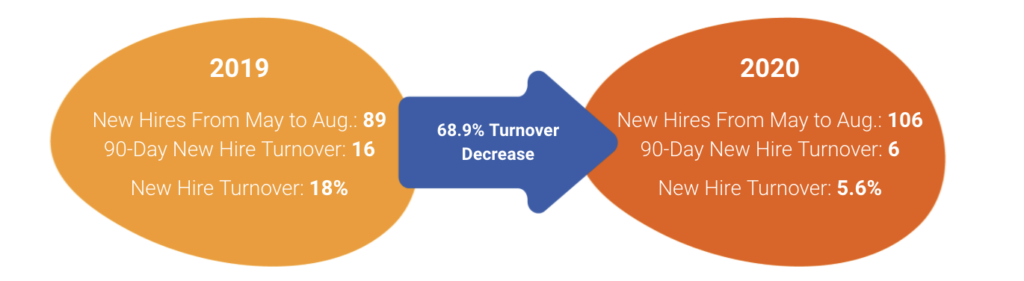
Medix Case Study: 68.9% Decrease in New Hire Turnover
Medix implemented the use of MyPrint into our onboarding programs and we’ve seen a positive impact on how we get to know our newest teammates. From personality styles to motivators, the MyPrint Collaboration Report has helped our new hires cultivate strong team relationships, leading to higher levels of engagement, retention and success in their new roles.
– Megan Steiger, VP of Human Resources.
.
THE CHALLENGE: NEW HIRE TURNOVER
With a higher than desired turnover rate for new employees in the first 90 days, Medix turned to Talentobe to determine how to better use soft skills data to reduce turnover rates.
THE SOLUTION: INNOVATION WITH COLLABORATION
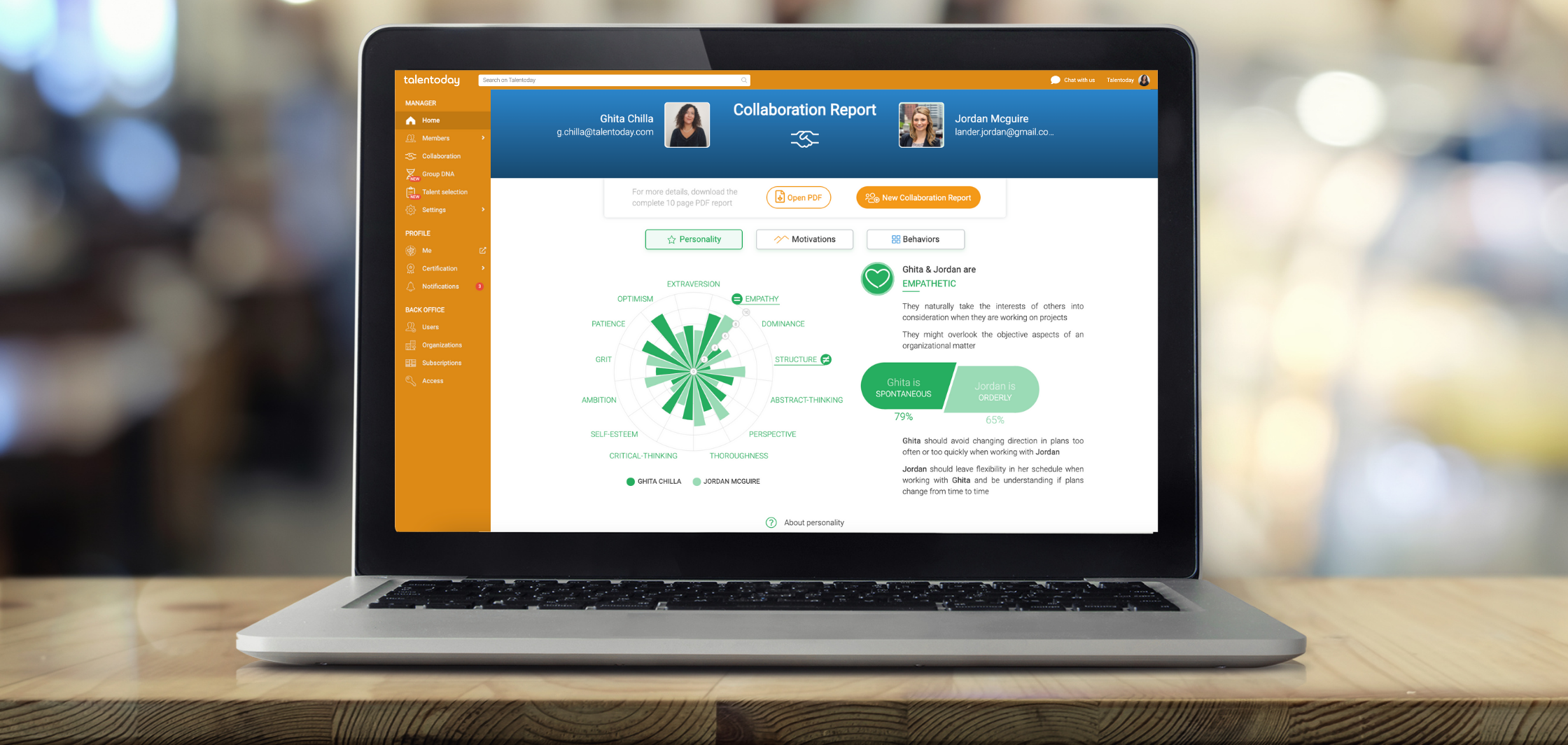
With HR working as a strategic business partner, Medix was able to empower managers and their direct reports to have enhanced collaboration with soft-skills data. Medix’s HR team implemented proactive collaboration sessions between managers and new hires based on Talentobe’s Collaboration Report, a 1:1 report designed to compare two individuals’ similarities and differences. The report provides guidance on how they can work better together better based on their unique MyPrint results. By implementing these sessions as proactive and voluntary, the buy-in is high among internal employees.
With HR acting as the facilitator, the manager and new hire are able to use the report to talk through examples that can help motivate them, and what discourages them, empowering engagement to work together towards business goals.
THE RESULT: A 68.9% DECREASE IN NEW HIRE TURNOVER
As a result, Medix saw a significant increase in employees staying with the organization past the first 90 days of employment. In fact, the organization experienced a 68.9 percent decrease in new hire turnover!
.
ABOUT THE CLIENT
Medix, a US-based staffing organization, has been pioneering staffing and digital services over the past twenty years. Being a purpose-led organization, Medix is guided by their core purpose to positively impact lives. In putting people at the heart of what they do, they take an innovative position as both an employer and staffing provider of choice by leveraging soft-skills insights as part of their holistic employee, talent, and client experience.
Since 2018, Medix has been leveraging Talentobe’s soft-skills assessment, MyPrint, and its personality, motivation and behavioral insights as part of their service offering to both talent and clients. Additionally, Medix designated an internal HR representative to champion MyPrint initiatives and infuse people analytics even further into Medix’s employee culture.
Ready to start your transformative Talentobe success story?

Behaviors Uncovered: Decision Making, Rule Consciousness, Risk Orientation and Change Reaction
So far, our Behaviors Uncovered series has explored seven total areas of observable actions made by individuals in conjunction with their work environment. Part one focused on Leadership Style, Communication Style, Conflict Management and Team Contribution. In part two, we highlighted Creativity, Work and Learning Styles; these are the behavior patterns that shape the ways individuals expand their knowledge base and work together to invent in the workplace. In this third and final entry in our series, the ways in which individuals relate to organizational structure and make choices take center stage. It’s time to uncover the science behind Decision Making, Rule Consciousness, Risk Orientation and Change Reaction.
As with the first two entries in this series, key information in the following descriptions is drawn from the Talentobe MyPrint® questionnaire. The behavioral dimensions found within the assessment are displayed as score matrices resulting from the combination of personality and motivational results. In short, our behavioral styles are predicted based on the scores (high or low) that an individual has obtained on these two dimensions crossed together. Think of these analytical grids as a way to gain a deeper understanding of why an individual prefers and maintains a particular pattern of actions.
Decision Making
When you start adding up the total number of decisions we make in the workplace on a daily basis, the results can be truly staggering. From soft balls like, “Hot coffee or iced coffee?” to everyday preferences like, “Does this request warrant a meeting or will an email suffice?” employees are constantly faced with choices to make. Eventually, some of these decisions can have a major impact on an organization. Having an idea of how an individual might go about this process can be key when building the right team for your goals.
Decision Making can be described as the set of processes, either intuitive or reasoned, by which an individual ends up choosing between two or more courses of action.
There are four ways individuals can approach decision making, derived from the “Perspective” dimension of personality and the “Need for Autonomy” dimension of motivation:
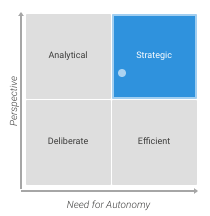
- Analytical (Big Picture, Need for Support): Individuals who are Analytical decision makers tend to consider multiple points of view in order to frame a situation very broadly.
- Strategic (Big Picture, Need for Self-Reliance): Individuals who are Strategic decision makers rely on their own assessment of a great deal of information to build solutions that stand the test of time.
- Deliberate (Focused, Need for Support): Individuals who are Deliberate decision makers consider just enough input from others to make a plan, but are ready to quickly adapt to the situation if need be
- Efficient (Focused, Need for Self-Reliance): Individuals who are Efficient decision makers value efficiency. They make up their minds quickly and move on to the next decision.
Rule Consciousness
How does your team approach structure? Any leader that has attempted to manage each employee with the same meeting schedule, expectations and firmness knows that, when it comes to workplace rules, it’s never truly one-size fits all. Rule Consciousness can be summarized as the way an individual interprets, judges and reacts to the organizational rules in place.
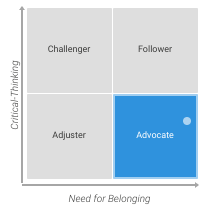
There are four behavior types when it comes to rule consciousness, derived from the “Critical Thinking” dimension of personality and the “Need for Belonging” dimension of motivation:
- Challenger (Critical-Thinker, Need for Freewill): Individuals who are Rule Challengers evaluate the rules and norms that are in place with great objectivity, and might choose their own way of doing things.
- Follower (Critical-Thinker, Need for Affiliation): Individuals who are Rule Followers go along with the rules, as it is a way for them to feel connected to others.
- Adjuster (Conventional-Thinker, Need for Freewill): Individuals who are Rule Adjusters are likely to try to bend the rules they strongly disagree with, or adjust them to their advantage.
- Advocate (Conventional-Thinker, Need for Affiliation): Individuals who are Rule Advocates show a strong respect for authority, and promote the existing rules or norms of any organization they belong to.
Risk Orientation
The decision to take a leap of faith in the workplace can be a stressful one for many employees. This takes rook in the ways that employees approach risk. Risk Orientation can be described as the way an individual invests energy in response to perception of significant uncertainty, namely in seeing either the opportunities or the obstacles. In some cases, a career defined by taking bold action can be beneficial. In other situations, a more conservative approach may be more warranted. Determining the outlooks held by members of a given team can help managers better chart the direction and pace the organization should be taking in order to maintain team confidence.
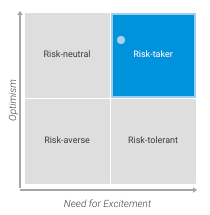
There are four ways an individual can approach risk, derived from the “Optimism” dimension of personality and the “Need for Excitement” dimension of motivation:
- Risk-neutral (Positive, Need for Safety): Individuals who are Risk-neutral strive to minimize their uncertainty by searching for the most rational solution.
- Risk-taker (Positive, Need for Adventure): Individuals who are Risk-takers expect positive outcomes from risky opportunities, making them typically go for them in order to maximize the gains.
- Risk-averse (Apprehensive, Need for Safety): Individuals who are Risk-averse focus on negative outcomes in risky opportunities, which typically makes them avoid them and choose safe alternatives.
- Risk-tolerant (Apprehensive, Need for Adventure): Individuals who are Risk-tolerant are open to deal with risky situations as long as they can determine solutions that reduce their potential losses.
Change Reaction
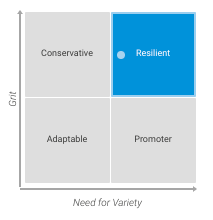
Change Reaction can be described as the typical response of an individual to the unexpected events or situations arising in their environment of work. Considering that a recent survey of half a million U.S. employees discovered that almost one-third of them do not understand why organizational changes are happening at any given time, it’s clear that employers need to do better when implementing change. One way to get there is by better anticipating the ways in which individuals might react when confronted with the news of adjustments to the workplace and processes.
Change reaction can be broken down into four possible patterns, derived from the “Grit” dimension of personality and the “Need for Variety” dimension of motivation:
- Conservative (Determined, Need for Consistency): Individuals who are Conservative in their reaction to change need to be convinced of the necessity of changes prior to overcoming them.
- Resilient (Determined, Need for Diversity): Individuals who are Resilient in their reaction to change tend to recover from changes by finding new ways of reaching their initial goals.
- Adaptable (Opportunistic, Need for Consistency): Individuals who are Adaptable in their reaction to change quickly adapt to changes occurring in processes, since they may represent an opportunity to adjust their goals.
- Promoter (Opportunistic, Need for Diversity): Individuals who are Promoters of change enjoy celebrating new events, and they typically welcome
If recent events have taught us anything, it’s that workplaces of all kinds need to be ready to tackle tough decisions and major transformations at any given moment. To navigate these fluctuations with skill, it pays for employers to have a deep understanding of the ways in which the individuals on their team approach the decision making process, rule consciousness, risk orientation and react when confronted with change.
When taken together with the personality and motivation dimensions of the MyPrint assessment, uncovering the behaviors of the individuals on your team can help you unlock the true potential hiding just under the surface.
Interested in uncovering more about how behavior profiles can help you understand how someone will act in a professional setting? Discover the science behind MyPrint by clicking here.
Race to Reshape Your Dream Team
As organizations anticipate post-pandemic life, business leaders are assessing their talent management challenges, looking to (re-)build a dream team and optimize performance. Companies are competing to hire top talent.
The workplace terrain has changed, and employers need to navigate the new normal of virtual work. Do you have who and what you need for your organization to be successful?
Talentobe offers insight into what to consider when building and shaping your team
- Use our checklist to shape your dream team.
- Get our coach’s guide on characteristics and traits to look for when hiring new employees in a remote work environment.
- Gain insight into how soft skills can help in hiring and motivating your team.
- Learn what traits support innovation, strategic thinking and problem solving.
- Find tips on cultivating an inclusive culture.
Click here to download our new infographic today!


Tell a Soft Skills Career Story in Your Next Job Interview
What makes for a great job interview? You know, one of those interviews that makes you say, “I totally nailed it. I know I’ve got the job. It’s time for a happy dance!”
Well, for one, it’s not about reciting your resume word-for-word like some sort of business robot (even if “the robot” is a fantastic choice for a happy dance). Instead, it’s about going beyond the resume to bring the story of your career to life. Then, taking that story a step further to connect your future to the goals of the employer.
The best storytellers don’t just list off events in the order in which they occurred. Instead, they draw the audience in by sharing the unique qualities of each character. In that same way, it’s time to transform your next job interview into an engaging story of what makes you unique as a candidate! To get there, you’ll have to shift the focus from a rehashing of professional milestones to what truly sets you apart — your soft skills!
Chapter 1: Soft Skills vs. Hard Skills
First and foremost, let’s lay out the difference between hard skills and soft skills. Hard skills, also commonly referred to as technical skills, are straightforward requirements for a position that employers can easily check off of a list. Does this applicant have the necessary degree? Did they complete training in this particular area? How many years of experience do they have in the industry?
Hard skills may be a prerequisite for getting your foot in the door, but soft skills are the key to unlocking the full power of your career story. These are the skills that touch on the less tangible elements of the way we work together. Soft skills bring to mind things like communication, leadership and teamwork. In other words, the elements of a great story!
Chapter 2: Identifying Your Soft Skills
If job interviews are all about storytelling, then every job candidate needs to build a narrative with a compelling beginning, middle and end. To start telling your story, think back to previous experiences in your work, education and outside activity history. What made you successful during those experiences? When did you fall short and why? What are you hoping to improve upon as you turn the page to a new chapter in your career?
As a starting point, consider using your resume as a reference. Then, begin writing out these key career moments from memory with soft skills as your focus, going beyond the bullet points to fill in the rich details. Unfortunately, our memories can only tell ourselves and our audiences so much about the way we interact with others in professional settings. In order to go deeper when identifying your soft skills, consider taking an assessment backed by science — like MyPrint®! Supporting anecdotal evidence from your career and experiences with tools built on data-driven people analytics can add credibility to your claims.
Chapter 3: Putting Soft Skills in Action During Questioning
Once you start seeing the job interview process through the lense soft skills, you’ll notice how many of the most common and difficult questions can be easily answered with soft skills in mind.
Here are five of the most common job interview questions, as well as the areas of soft skills employers are look for in your response:
- Can you tell me about a time when you overcame a significant challenge at work?
- What happens when you have multiple deadlines and how do you prioritize?
- Give me an example of when you had to work closely with someone who was difficult to get along with. How did you handle interacting with that person?
- Can you tell me about a time when you had to ask for help?
- What is your preferred management style?
When you answer questions like these, answer with your soft skills! If you are unsure what your strengths are, look at your MyPrint One Pager. What are your top three personality strengths? For example, if you are Empathetic, you might excel working with difficult people because you can put yourself in their shoes and understand why they behave in certain ways. If you are Easy-Going and know that details aren’t your forte, you might be more inclined to reach out to a detail-oriented colleague when you have projects that require precision. The more concrete the example you can share, the better!
Writing an Ending with Confidence
It’s a tale as old as time — the job candidate makes it to the end of the job interview journey only to feel like they missed out on a golden opportunity. One way to avoid this tragic fate is to turn your job interview into a story about soft skills! Prepare for your next meeting with a potential employer by thinking about your career as chapters, each highlighted by the traits that make you unique.
Are you looking to turn your next job interview into the story of your soft skills? Click here to take MyPrint and receive a detailed assessment of your unique personality, motivational and behavioral traits!